|
 |
 |
 |
 |
 |
 |
 |
 |

 |
Chip Design Has Potential As Artificial Retina
Washington - Apr 08, 2002 A new type of analog processor that is compact while offering extremely fast computations for image processing could possibly lead to the creation of an artificial eye that has the potential to replace damaged human retinas, offering sight to the blind if the chip works as planned. The cellular nonlinear network (CNN) analog computer chip is integrated with a camera to produce an image processor. The innovation is the 1 cm-square CNN chip that can increase processing speed while reducing the power requirements over standard digital chips by two to three orders of magnitude. The retina application of the CNN chip is the work of three scientists funded by the Office of Naval Research (ONR). The scientists, who were developing nonlinear circuit theories, realized that their chip mimicked the functions of the retina. "This could be the basis for the creation of a real artificial eye that works just like a retina," said Dr. Larry Cooper, ONR program manager for the CNN project. "The CNN chip is small and fast and has programmable capability." Other potential medical applications in addition to the artificial eye include real-time diagnosis for heart monitoring and ultrasound imaging of the heart for real-time 3-D heart images. A clinic in Bonn, Germany is already trying out the CNN chip to analyze electroencephalogram (EEG) data, allowing researchers to predict the occurrence of epileptic seizures and, perhaps, even prevent seizures from beginning. Researchers are already developing a larger array for better images and are using the chips for automatic target recognition for missiles while also allowing missiles to differentiate between targets and decoys. Community Email This Article Comment On This Article Related Links Office of Naval Research SpaceDaily Search SpaceDaily Subscribe To SpaceDaily Express All about the robots on Earth and beyond!
 Engineers Deliver Robot to Neutralize Remote Explosives
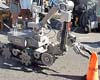 Tyndall AFB (SPX) Jun 30, 2005
Engineers from the Air Force Research Laboratory Materials and Manufacturing Directorate have rapidly prototyped, developed, and delivered low-cost expendable robots to disable and dispose of improvised explosive devices. |
|
|

| The content herein, unless otherwise known to be public domain, are Copyright 1995-2006 - SpaceDaily.AFP and UPI Wire Stories are copyright Agence France-Presse and United Press International. ESA PortalReports are copyright European Space Agency. All NASA sourced material is public domain. Additionalcopyrights may apply in whole or part to other bona fide parties. Advertising does not imply endorsement,agreement or approval of any opinions, statements or information provided by SpaceDaily on any Web page published or hosted by SpaceDaily. Privacy Statement |