|
 |
 |
 |
 |
 |
 |
 |
 |

 |
Chinese media silent on 40th anniversary of Cultural Revolution
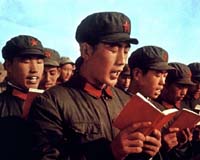
Beijing (AFP) May 16, 2006 China's state-controlled media were silent Tuesday over the 40th anniversary of the start of the tumultuous Cultural Revolution, still seen as a taboo subject that haunts the country. All mainstream media -- newspapers, television and radio stations -- stayed mum on the subject as did popular websites, whose chatrooms are normally filled with lively discussions on topical issues. Searches on Tuesday for "Cultural Revolution" under the news section on China's most popular search engine, Baidu, yielded no results while specific websites focused on the period were not accessible. Apart from several regional or academic magazines with limited circulation that have published articles on the troubled decade during the past two months, there has been a virtual media black-out on the issue. The Communist Party's propaganda department controls the nation's media, giving the authorities powerful leverage to decide what gets reported. China has planned no commemorative activities, reflecting the official position that the last word has already been said about the period. The official verdict, which was delivered in 1981, said the movement was responsible for "the most severe setback and the heaviest losses" in the country since the founding of the Communist Party's republic in 1949. Chinese foreign ministry spokesman Liu Jianchao last week repeated the official line that the movement was "10 years of catastrophe," but stopped short of elaborating. "There was already a verdict reached. I think there has been no change to that," he told a press conference when asked. State media did not report on his comments and the ministry deleted them from its website transcript of the press conference. Analysts and witnesses of the movement said China was avoiding the anniversary date because it feared any reminder of the decade of terror and violence would risk making Chinese people doubt the legitimacy of the regime. But they warned that doing so was dangerous as it meant China's younger generation would have no understanding of the events and that older Chinese could not properly reflect and repent for any wrong-doings. "This silence, to me, is lamentable and is dangerous from a historical point of view," said Lu Yuegang, a veteran journalist and former deputy editor of an outspoken news publication, Bingdian. "This self-deceiving silence is a tragedy to our nation. If there is no reflection, there is no hope for the future." The Cultural Revolution officially began on May 16, 1966, with a directive from Communist chief Mao Zedong charging that "representatives of the bourgeoisie" had infiltrated all levels of the party and must be "cleansed". Mao ostensibly wanted to get rid of a new elite class of bureaucrats in the party to create a classless world free of oppression, but his desire to eliminate those who threatened him politically is now seen as a stronger motive. Mao's political tools were millions of students and workers, who became his "Red Guards", hounding millions across the country and destroying any objects deemed symbols of "feudalist oppression" such as artworks and religious relics. The end of the Cultural Revolution came just weeks after Mao's death in September 1976. The 1981 official verdict put the blame on the Gang of Four -- the most prominent member being Mao's wife Jiang Qing -- although scholars have suggested Mao's tacit endorsement rendered him just as guilty. The verdict said Mao made "gross mistakes" but also stated his contributions were far greater, hence preserving the Chairman's stature as the "great leader" while maintaining the legitimacy of Party rule. Liberalist intellectual and veteran Communist Party member He Jiadong said the present regime, under which people are still not enjoying democracy and political freedom, was only a continuation of Mao's autocratic system. It was therefore afraid of bring up the historical issue out of fear that ordinary Chinese people would doubt its legitimacy, he said. Community Email This Article Comment On This Article Related Links China News from SinoDaily.com
 Drought threatens food supply in western China
 Rome (AFP) May 15, 2006
 Large swathes of north and west China face food shortages because of a prolonged drought that has dried up reservoirs and wells, and destroyed more 60 percent of the winter wheat crop in the worst-hit areas, the Food and Agriculture Organization said Monday. |
|
|

| The content herein, unless otherwise known to be public domain, are Copyright 1995-2006 - SpaceDaily.AFP and UPI Wire Stories are copyright Agence France-Presse and United Press International. ESA PortalReports are copyright European Space Agency. All NASA sourced material is public domain. Additionalcopyrights may apply in whole or part to other bona fide parties. Advertising does not imply endorsement,agreement or approval of any opinions, statements or information provided by SpaceDaily on any Web page published or hosted by SpaceDaily. Privacy Statement |