|
 |
 |
 |
 |
 |
 |
 |
 |

 |
Chinese Spacecraft Undergoes Manoeuvre To Correct Orbit Path
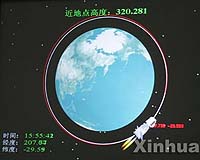
Jiuquan (AFP) Oct 14, 2005 China's second manned space flight, Shenzhou VI, underwent a maintenance operation early Friday to put the vessel back onto its original orbiting path after deviating a day before, state media said. The operation began shortly before 2200 GMT Thursday during the spacecraft's 30th flight around the Earth, the Xinhua news agency said. The operation successfully restored the vessel to its original trajectory after slightly deviating from its preset orbit on Thursday, the agency quoted the Beijing Aerospace Command and Control Center as saying. It said the vessel would later undergo another similar operation to fix the orbiting path. The vessel, which took off early Wednesday, has been moving a little closer to the Earth due to gravity, Xinhua said. A US-based China space expert told AFP that while all orbits require some level of maintenance, the deviation was still unusual and "disturbing." "Especially for a manned craft... you're going to know what orbital path you're going to put it in and you're going to expect it to stay there," said Dean Cheng, senior Asia analyst with the Virginia-based nonprofit technical analysis think tank Center for Naval Analyses or CNA Corporation. "In and of itself, it's not a big deal. What they haven't said is how after such extensive planning, why are they making changes? The question is what went wrong?" Shenzhou VI is expected to remain in orbit for up to five days, exceeding the time spent in space during China's first manned flight in 2003, when astronaut Yang Liwei aboard Shenzhou V stayed in space for 21 hours.
Chinese Spacecraft Deviates Slightly From Preset Orbit On Second Day China's second manned space flight, Shenzhou VI, has deviated "slightly" from its preset orbit, but was otherwise operating normally, state media said Thursday on the second day of the mission. "The spacecraft, which blasted off on Wednesday morning with two astronauts aboard, has slightly deviated from its designed orbit and (is) moving a little closer to the Earth due to gravity," the Xinhua news agency said. As a result, the spacecraft will undergo its first orbit maintenance operation in the early hours of Friday to restore the vessel to its original trajectory, it said. Xinhua cited unnamed experts saying the maintenance will be a "normal technical operation" and similar tasks could be carried out in the future depending on how the spacecraft was orbiting. China's first manned mission in October 2003 made the country the third in the world after the former Soviet Union and the United States to send a man into space. The second mission, Shenzhou VI, is much more difficult, carrying two men instead of one and is expected to travel in space for up to five days, instead of only 21 hours in the first mission. Experts said it was not surprising there are complications. "There are always glitches, problems that can go wrong, especially in the early stages of space flight," said Derek Mitchell, a senior fellow at the US-based Center for Strategic and International Studies. Another US-based China space expert said that while all orbits require some level of maintenance the deviation was still unusual and "disturbing". "Especially for a manned craft ... you're going to know what orbital path you're going to put it in and you're going to expect it to stay there," said Dean Cheng, senior Asia analyst with the Virginia-based think tank Center for Naval Analyses or CNA Corporation. "In and of itself, it's not a big deal. What they haven't said is how after such extensive planning, why are they making changes? The question is what went wrong?" However, Chen Lan, a Beijing-based independent analyst who has been following China's space program for years, said deviations were "very normal". "Ever so often they have to make adjustments to get it back in its exact path," said Chen. He said orbital maintenance maneuvers were carried out on the Shenzhou II to Shenzhou IV missions, which were unmanned and lasted several days, but not on the last one, Shenzhou V, as far as he could remember, because that was a much shorter flight. "It's routine work. They've planned for this," said Chen. Officials in China's space program could not be reached for comment. The US-based Cheng said he believed China could put the spacecraft back on its correct orbit. "It's not a particularly difficult, it's not a particularly dangerous maneuver," he said. "The pilots themselves can do it or they can do it from ground control." Meanwhile, the two astronauts onboard the Shenzhou VI successfully conducted experiments and tested their life support systems Thursday, Xinhua said. All systems on Shenzhou VI were working normally, and the spacecraft had circled the earth for 23 times by Thursday evening, Xinhua cited officials from the mission control center in Beijing as saying. Astronauts Fei Junlong and Nie Haishengs' physical conditions were good. Unlike China's first astronaut who never left his seat in the re-entry capsule two years ago, Fei and Nie have already left the re-entry capsule and entered the orbital capsule, shedding their bulky suits and donning ordinary work clothes so they can move around easily. But Xinhua cited experts warning: "Although everything proceeds smoothly so far, all scientific and technological staffs need to be cautious." Community Email This Article Comment On This Article Related Links SpaceDaily Search SpaceDaily Subscribe To SpaceDaily Express The Chinese Space Program - News, Policy and Technology China News from SinoDaily.com
 Taikonauts On Moon A Far Off Dream For China Yet
 Beijing (XNA) Jan 05, 2006
A one-year lunar fly-by mission may start in April 2007 in China, but a manned flight to the Earth's neighbour may be a long way away, a chief lunar exploration scientist said last night. |
|
|

| The content herein, unless otherwise known to be public domain, are Copyright 1995-2006 - SpaceDaily.AFP and UPI Wire Stories are copyright Agence France-Presse and United Press International. ESA PortalReports are copyright European Space Agency. All NASA sourced material is public domain. Additionalcopyrights may apply in whole or part to other bona fide parties. Advertising does not imply endorsement,agreement or approval of any opinions, statements or information provided by SpaceDaily on any Web page published or hosted by SpaceDaily. Privacy Statement |