|
 |
 |
 |
 |
 |
 |
 |
 |

 |
Chinese Scientists To Explore Highest Icecap In Antarctica
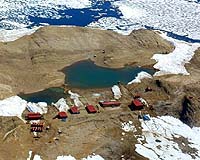
Beijing (XNA) Oct 18, 2004 A 12-man Chinese expedition will leave Shanghai for Antarctica on October 25, targeting the highest polar icecap peak- 4,039 meters above sea level- in preparation for setting up the third Chinese scientific research station on the continent. This will be the 21st Antarctic expedition conducted by Chinese scientists, and the first time for any expedition teams to explore Dome A Icecap, located at 81 degrees south latitude and 77 degrees east longitude. "The major task of the expedition is to prepare for setting up the third Chinese scientific research station on Antarctica," said Wei Wenliang, an official for polar expedition affairs with the State Oceanic Administration. However, he declined to give the exact time for the establishment, only saying that the station will be built from 2006 to 2010. When the team reach the top of the Dome A icecap, Wei said, they will set up a temporary meteorological station and conduct various research activities, including extracting ice samples deep from under the ground. "They will also test whether it is suitable for human beings to live in the harsh environment there," he said. China has so far built two research stations on Antarctica. The Great-Wall Station, founded in February 1985, is located south of King George Island, and Zhongshan Station, built in February 1989, is located south of Prydz Bay on the Mirror Peninsula, eastern of Larsemann Hills. "The expedition team is expected to arrive in the Zhongshan Station in late November and begin a 70-day expedition on Antarctic in early December," said Li Yuansheng, head of the expedition team and a research fellow with the Shanghai-based Chinese Polar Research Institute. Source: Xinhua News Agency Community Email This Article Comment On This Article Related Links SpaceDaily Search SpaceDaily Subscribe To SpaceDaily Express Nuclear Space Technology at Space-Travel.com
 Rewriting Glacial History In Pacific North America
 Edmonton AB (SPX) Jan 10, 2006
Although the story on glacier fluctuations in northwestern North America over the last 10,000 years has remained largely unchanged for decades, new evidence discovered by a University of Alberta researcher will rewrite that glacial history and offer clues about our climate history during the last several thousand years. |
|
|

| The content herein, unless otherwise known to be public domain, are Copyright 1995-2006 - SpaceDaily.AFP and UPI Wire Stories are copyright Agence France-Presse and United Press International. ESA PortalReports are copyright European Space Agency. All NASA sourced material is public domain. Additionalcopyrights may apply in whole or part to other bona fide parties. Advertising does not imply endorsement,agreement or approval of any opinions, statements or information provided by SpaceDaily on any Web page published or hosted by SpaceDaily. Privacy Statement |