|
 |
 |
 |
 |
 |
 |
 |
 |

 |
Chinese Peasants Benefit From "Golden Week" Holidays
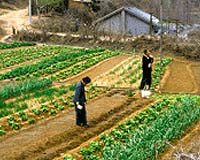
Nanjing (XNA) Oct 03, 2006 Seven years after the Chinese government started to promote tourism and consumption with the introduction of "golden week" holidays, peasant farmers have begun to benefit. More and more city people are taking advantage of the weeklong holidays around Chinese Lunar New Year, Labor Day on May 1 and China's National Day on Oct. 1 to head out to the countryside to enjoy fresh air and organic food. For peasant farmers equipped to offer hospitality, the influx of tourists means huge profits. "I started to host tourists in 2004. Last year, I made 20,000 yuan (2,500 U.S. dollars) in net profits," said Zhou Fachun, a peasant farmer in Zhoujia'ao Village, eight kilometers from the city center of Nanjing, in east China's Jiangsu Province. "It feels wonderful to be running a business from home," he said. Sixteen out of the 78 families in Zhou's small village take in tourists during the holiday periods. The three most successful family businesses are making 200,000 to 300,000 yuan (25,000 to 37,500 U.S. dollars) a year. "Chinese people started celebrating 'golden week' holidays in 1999 and more than 100 million holiday train trips are made each year," said Prof. Zhou Yingheng, president of Nanjing Agricultural University's School of Business Administration. For years, only city dwellers enjoyed the holidays. The 900 million peasants who make up the vast majority of the Chinese population were left out, he said. The huge gap between Chinese cities and the countryside means that peasant farmers are at least 15 years behind their city peers in terms of consumption. Even in the richer eastern provinces, the gap is around 10 years, according to Zhou's research. But the booming countryside tours have helped narrow the gap, according to a local tourism official in the suburbs of Nanjing. "The influx of tourists to the countryside has not just helped peasant farmers increase income, but also increased the added value of local agricultural production," said Xie Wencai, an official in suburban Yuhua District. The State Tourism Administration says Chinese tourists are making at least 300 million trips to the countryside each year, generating more than 40 billion yuan (5 billion U.S. dollars) of tourism income. In the meantime, some better-off farmers have joined their city peers in sightseeing or shopping tours during "golden week" holidays. "I'm busy most of the year, but I manage to travel with my family almost every year," said Chen Xiangzhan, a farmer-turned-businessman from Yongjia county in Wenzhou, a booming manufacturing center in rich Zhejiang Province. For the National Day holiday, Chen and his family went to Ningxia Hui Autonomous Region, a Muslim community in the northwest that is far less developed than his hometown. But even in remote Ningxia, a sightseeing tour to Beijing or even Hong Kong is no longer "pie in the sky" for every farmer. "We've sent nearly 1,000 peasant farmers on package tours outside Ningxia. Many of them traveled to Beijing and some to Hong Kong and Macao," said Zhang Yonghua, vice managing director of Ningxia Overseas Tourism Co. Chinese farmers made 640 million sightseeing tours in 2004, the most recent period for which State Tourism Administration data is available. That year, farmers' tourism spending totaled 135 billion yuan (about 17 billion U.S. dollars), it said.
Source: Xinhua News Agency Community Email This Article Comment On This Article Related Links China News From SinoDaily.com China News from SinoDaily.com
 China Strives For Free Compulsory Education For All
 Beijing (XNA) Oct 06, 2006
The new semester in March 2006 was different from others for Shang Zhibo in Manhai Elementary School of Manhai Village in Yunnan Province. For the first time in his six-year teaching career, he announced to his fifth-grade class of 16 students that they no longer needed to pay their 80 yuan (US$10) school fees. |
|
|

| The content herein, unless otherwise known to be public domain, are Copyright 1995-2006 - SpaceDaily.AFP and UPI Wire Stories are copyright Agence France-Presse and United Press International. ESA PortalReports are copyright European Space Agency. All NASA sourced material is public domain. Additionalcopyrights may apply in whole or part to other bona fide parties. Advertising does not imply endorsement,agreement or approval of any opinions, statements or information provided by SpaceDaily on any Web page published or hosted by SpaceDaily. Privacy Statement |