|
 |
 |
 |
 |
 |
 |
 |
 |

 |
Chinese Benefit From Booming Space Technology
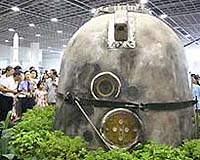
Beijing, (XNA) Oct 09, 2005 "What a sweet, jucy and tasty fruitit is!" says Li Xiaoliang, a local resident in this national capital, while enjoying a kind of grape known as "Space Grape" with its seeds bred with space technology. Grape is one of some 800 kinds of earth plants that have had their seed strains experimented with in the space by Chinese scientists in the past 18 years since 1987, according to official figures. In present China, many commoners like Li have benefited from space technology as it has become one of the few nations able to shot their own rocket carriers and send satellites and space vehicles into the orbit. "With telecommunications satellites in orbit, more than 100 kinds of modern businesses including cell phone and remote medical service are now available, which have largely altered the way of our life," says Gu Yidong, designer-in-chief of the application system of China's manned space program. Since China launched its first pilot telecom-satellite in 1984,satellite-based TV and radio programs have covered over 90 percent of the Chinese population. With the help of telecom-satellites, the Earth has become a village where people can learn about international news and watch an Olympic Game simultaneously, share information about natural calamities and climatic conditions worldwide, and inspect natural resources. "The outer space is called 'the Fourth Territory' for the Humankind," acknowledged Gu, who also said he believes that space technology could bring human beings a better life in the future. With the increasingly wide use of space technology, scientists can develop a lot of new things nonexistent before, according to Hu Wenrui, a member of the Chinese Academy of Sciences and the International Space Academy. "Every time a new structure of protein is analyzed, a new type of pharmaceutical product comes into being," says Hu, adding spacetechnology can also help cut the cost of industrial production. China plans to send its second manned spacecraft later this month, ushering in a new wave of space craze among the Chinese people.
Community
 Taikonauts On Moon A Far Off Dream For China Yet
 Beijing (XNA) Jan 05, 2006
A one-year lunar fly-by mission may start in April 2007 in China, but a manned flight to the Earth's neighbour may be a long way away, a chief lunar exploration scientist said last night. |
|
|

| The content herein, unless otherwise known to be public domain, are Copyright 1995-2006 - SpaceDaily.AFP and UPI Wire Stories are copyright Agence France-Presse and United Press International. ESA PortalReports are copyright European Space Agency. All NASA sourced material is public domain. Additionalcopyrights may apply in whole or part to other bona fide parties. Advertising does not imply endorsement,agreement or approval of any opinions, statements or information provided by SpaceDaily on any Web page published or hosted by SpaceDaily. Privacy Statement |