|
 |
 |
 |
 |
 |
 |
 |
 |

 |
China's mega dam built to defy attacks from terrorists, enemies
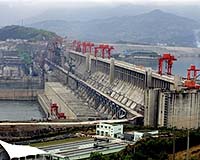
Yichang, China (AFP) May 18, 2006 China's Three Gorges Dam across the Yangtze River, the world's largest hydropower project, shows the nation at its most powerful, but also makes it vulnerable in entirely new ways. For the past nearly two decades, during design and construction of the dam, planners have engaged in a low-key effort to make sure it is protected from hostile forces -- whether terrorists or nations at war with China. The measures they have come up with range from building an extra-solid structure, to posting elite paramilitary troops in the immediate vicinity of the dam and, if all else fails, quickly emptying the reservoir. "The security of the dam, and in particular protection against terrorist attack, is something we take very, very seriously," said Cao Guangjing, vice president of the China Yangtze Three Gorges Project Development Co. "We paid special attention to preparation against military attack in the preliminary design phase of the dam," he said. The spirit of immense confidence and pride that permeates the entire Three Gorges project also affects most engineers' attitude towards the idea of an attack on the 2.3-kilometer-long (1.42-mile-long) dam. "Nothing will happen," said Feng Zhengpeng, director of hydropower complex management. "China is rising and I'm not afraid any nation will attack. Anyone that wishes to attack China today has to think very carefully about it first." That may be, but history shows dams are tempting targets in war. In 1943, at the height of the Second World War, Britain's Bomber Command destroyed two dams in Nazi Germany, wreaking havoc on its infrastructure and killing more than 1,000 people. In its 2004 report to US Congress on China's military power, the Pentagon also suggested that an attack on the dam might be one of Taiwan's options in case of war with China. "Since (Taiwan) cannot match Beijing's ability to field offensive systems, proponents of strikes against the mainland apparently hope that merely presenting credible threats to China's urban population or high-value targets, such as the Three Gorges Dam, will deter Chinese military coercion," it said. In one of the more obvious signals of China's security precautions, a detachment of the paramilitary People's Armed Police is kept just next to the dam. "What you can actually see is just one piece of the effort," said Cao. "We have emergency plans to cope with all possible eventualities." According to earlier reports in the state media, China has deployed military helicopters, patrol boats, armored vehicles and bomb disposal units near the 180-billion-yuan (22.5-billion-dollar) project. China has conducted several rounds of anti-terrorist exercises in the area, including one that simulated an assault with a boat brimming with explosives. The dam is robustly built, and officials say it will be able to withstand any conventional attack, whether from terrorists or from hostile foreign powers. It is also located more than 1,000 kilometers (620 miles) from any coastline, making it a harder target, Cao argued. The worst-case scenario would be an assault with a nuclear weapon. In that case, China has only one option, according to Cao. "If there's a nuclear attack, the main procedure will be to draw down the whole reservoir," he said. "The Three Gorges dam is equipped with sufficient flood discharge capacity." The crucial job to get done before the enemy can strike is to empty the reservoir of the 22 billion cubic meters (770 billion cubic feet) accumulated above the 145-meter mark. That could be done in as little as two to three days, as the dam is able to release up to 110,000 cubic meters per second, Cao estimated. It takes a lot less time for a nuclear missile to strike, and if these precautions fail, and the dam takes a direct hit, disaster would be impossible to prevent. The only question would be how much it could be curbed. But officials claim computer simulations have shown that the damage would not go all the way down to Shanghai where the Yangtze spills into the East China Sea. "While preparing for the dam, we conducted a lot of studies into what would happen if it were destroyed," said Wang Xiaomao, deputy chief engineer at the Yangtze River Water Resources Committee. "Even if there is a war and the dam is wracked, there'll be limited damage." The state-controlled China Daily newspaper reported last year that channels had been dug out downstream to divert excess water released from a wrecked dam. Officials said probably the best argument for going ahead with the dam was the idea that nothing would ever be built if you were overpowered by anxiety that it might be broken. "The construction of the Three Gorges dam will be very beneficial to China's economy, and we should not give up this development opportunity just because we fear war," said Cao. Community Email This Article Comment On This Article Related Links Water News - Science, Technology and Politics
 Three Gorges Dam: China's Great Wall on the Yangtze
 Yichang, China (AFP) May 18, 2006
 The Three Gorges Dam, which will reach completion Saturday, is China's Great Wall across the Yangtze River, a project that many expect to be a source of immense national pride for centuries. |
|
|

| The content herein, unless otherwise known to be public domain, are Copyright 1995-2006 - SpaceDaily.AFP and UPI Wire Stories are copyright Agence France-Presse and United Press International. ESA PortalReports are copyright European Space Agency. All NASA sourced material is public domain. Additionalcopyrights may apply in whole or part to other bona fide parties. Advertising does not imply endorsement,agreement or approval of any opinions, statements or information provided by SpaceDaily on any Web page published or hosted by SpaceDaily. Privacy Statement |