|
 |
 |
 |
 |
 |
 |
 |
 |

 |
China's cold snap to heat up inflation, investment: analysts
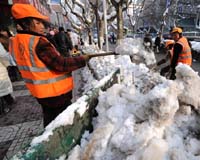
Beijing (AFP) Feb 17, 2008 China's worst winter weather in half a century will fuel inflation and investment problems in the Asian giant's runaway economy, while the rest of the world may also feel its impact, analysts say. Weeks of heavy snow and freezing cold swept across densely-populated provinces in south China this month and last, destroying crops and wreaking havoc on infrastructure that proved much more fragile than previously imagined. "The snow storm is a classic negative supply shock to the economy, and is set to drive inflation up," Lehman Brothers economist Sun Mingchun said. Inflation is already running at levels not seen for a decade and China's communist rulers, wary about potential social unrest, have identified taming the problem as one of their top concerns. But hampering their efforts, several crucial product categories were impacted as 18 provinces were struck by winter weather of a ferocity only people aged over 60 remembered seeing before. The price of coal, which provides about 70 percent of China's energy needs, is likely to go up, partly as a result of transport bottlenecks making it a desperately needed commodity in some parts of the country. In China, one fourth of all locally produced coal is transported by truck, meaning chaos when road arteries are paralysed by ice or impenetrable blizzards. "The government has basically decided for 2008 to let coal prices be determined by the markets," said Han Yong, a coal analyst with China International Capital Corp. "But it may nevertheless decide to adopt special measures if coal prices rise at a too steep rate." The prices of agricultural goods have been major factors in driving up inflation -- which hit 6.9 percent in November and 6.5 percent in December -- and will likely become even more of a problem after the winter shock. "It's mainly the southern area that has been affected by the snow, with an impact on winter wheat, rapeseed and fruit," said Zhu Jianfang, a Beijing-based economist with Citic Securities. "Over the short term, inflation will definitely be impacted. We initially believed inflation would be about 4.5 percent this year, but we're now inclined to think it will hit five percent," he said. This could become more than just China's own problem if it decides to access world markets to make up for strained supplies at home. "The snow storms are affecting 10 percent of China's farming land. One of the solutions is that the government may start importing more grains and meat," said Dong Tao, an economist with Credit Suisse. "Given the size of the Chinese population, I think this will have an impact on global soft commodity prices and global inflation." Just as China's efforts to fight inflation have not been helped by the weather, the same is true for its endeavour to curb investment spending, a main engine for the nation's near-overheated economic growth in recent months. New investment is likely to be unavoidable in the coming months, and not just because of the need to repair toppled telephone poles and frost-damaged power lines. China may have to spend extra money on its transport network, which proved inadequate in the severe winter weather, analysts said. Hundreds of thousands of passengers were stranded ahead of the most important holiday of the year, the Lunar New Year. "Under normal circumstances, there aren't major problems. Sure, the transportation network gets a little crowded, and may come under momentary stress, but it's only momentarily," said Citic Securities' Zhu. "This is supposed to be the worst snow in 50 years, but if it's the result of global warming, we can expect it to become more common in future. In that case, we'll probably have to have more investment." Community Email This Article Comment On This Article Related Links China News from SinoDaily.com
 Mao proposed sending 10 million Chinese women to US
 Washington (AFP) Feb 12, 2008
Chinese leader Mao Zedong proposed sending 10 million Chinese women to the United States, in talks with top envoy Henry Kissinger in 1973, according to documents released Tuesday. |
|
|

| The content herein, unless otherwise known to be public domain, are Copyright 1995-2007 - SpaceDaily.AFP and UPI Wire Stories are copyright Agence France-Presse and United Press International. ESA Portal Reports are copyright European Space Agency. All NASA sourced material is public domain. Additional copyrights may apply in whole or part to other bona fide parties. Advertising does not imply endorsement,agreement or approval of any opinions, statements or information provided by SpaceDaily on any Web page published or hosted by SpaceDaily. Privacy Statement |