|
 |
 |
 |
 |
 |
 |
 |
 |

 |
Chinas Looming Shadow
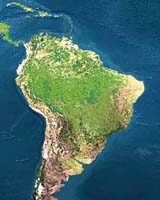
Washington (UPI) Mar 10, 2006 Chinese influence is increasing in Latin America and Africa, a phenomenon that could have substantial bearing on America's foreign policy on these regions, say analysts. "America's influence could be seriously eroded," while Chinese influence will only increase, said Stephen Johnson, senior policy analyst at the Heritage Foundation in Washington. Referring to the "plantation economy" being created in Latin America as a result of China's substantial influence on the economy, he said that the United States should rely more on competition in order to get a foot back in the door as a major player. China, the world's fourth largest economy, with the third largest deficit budget and the largest growing population, needs to increase currently insubstantial domestic resources to feed a growing economy. According to Johnson, Latin America is "ripe to be exploited by some major power," as a result of much social and economic upheaval. "Powerful presidents impose public agendas that are out of touch," he said, "allowing for arbitrary rule with a democratic veneer." The People's Republic of China, still functioning as a non-market economy, is the United States' second largest trade partner after Canada. Says Johnson, the advantage of trading with China is that "China makes deals on the spot, without a lot of strings." Additionally, the novelty of frequent visits from high-level Chinese officials elevates a small country into "big leagues" -- while ranking American officials tend to ignore many of the Latin American countries. "The instrumental nature of Chinese ownership means that many of China's loans are really not direct investment," said R. Evan Ellis, an associate at Booz Allen Hamilton. "The clash of Chinese management practices and cultural expectations of Latin American workers," is one problem that is already showing face, said Ellis. With the displacement of the manufacturing sector in Latin America -- the region has lost export opportunities to the United States and European Union as China bears increasing influence on domestic markets -- social unrest will be a huge issue. According to him, the threat to the United States from China may not be a matter of an evolving military threat, but more an undermining of U.S. security needs. This may be played out in the increased cultural migration to the United States from Latin America. As China looks across the world to secure its economic growth and national security, there will be both advantages and disadvantages of its increased foray into not only Latin America but also Africa. "No other nation in the world is more in need of economic development than sub-Saharan Africa," said Brett D. Schaefer, Research Fellow in International Regulatory Affairs at the Heritage Foundation, "and commitment to democracy is fairly shallow." Yet in an era where radical terrorists have an evident foothold in the African subcontinent, the 52 countries that make up the nation suddenly have sizeable relevance. "You can't separate China and Africa out from these overall broad concerns," he said. China is active in natural resources -- oil, water and timber -- all over the continent. Exemplified by its "protection over rogue states," Schaefer said that military cooperation has grown largely in terms of protecting Chinese investments -- such as majority control over Sudan's oil resources. "China pursues its own self-interests without regard for a lot of African governments, countering western influences who would like to see improved government and greater transparency," among other things, he said. However, China is, to some extent, also good for the developing regions of Latin America and Africa, say the analysts. Investment in hard infrastructure and agriculture, among other things, are neglected by the west and much needed. In Africa, China also has peacekeeping operations and a number of doctors serving. Africa's history with China dates back to colonial times. Josh Eisenman, Fellow in Asia Studies at the American Foreign Policy Council, said that many Chinese made investments have a political basis. Additionally, Chinese companies are nearly always under state control -- giving them broad leadership powers, which nations find useful in being able to proverbially "kill two birds with one stone." One hand determines investment opportunities and the other discusses matters of state -- such as military cooperation. This, says Eisenman, is especially helpful for African nations, while also enabling China to "use and leverage its seat on the Security Council." Increasing goodwill has also extended to hosting upcoming leaders in Chinese military academies, providing interpersonal ties for influence at a later time. "United States policy should make competition a true priority," said Johnson. By increasing trade relations, America can and will open up market access, he said. At the same time, cutting strings on assistance to the greatest extent possible and pressing harder for reforms will enable the United States to dodge the fear of China's looming shadow. "I think the jury's still out; we don't know if these investments will play out," said Eisenman, "China's values are not U.S. values and we've got to remember that."
Source: United Press International Community Email This Article Comment On This Article Related Links - Learn about the Superpowers of the 21st Century at SpaceWar.com Learn about nuclear weapons doctrine and defense at SpaceWar.com
 India Says US Deal Wont Harm Nuclear Deterrent
 New Delhi (AFP) Mar 07, 2006
The landmark India-US nuclear pact will not hurt India's nuclear deterrent capacity or its national interests, Prime Minister Manmohan Singh told parliament Tuesday."The integrity of our nuclear doctrine and our ability to maintain a minimum credible nuclear deterrent is adequately protected," Singh said |
|
|

| The content herein, unless otherwise known to be public domain, are Copyright 1995-2006 - SpaceDaily.AFP and UPI Wire Stories are copyright Agence France-Presse and United Press International. ESA PortalReports are copyright European Space Agency. All NASA sourced material is public domain. Additionalcopyrights may apply in whole or part to other bona fide parties. Advertising does not imply endorsement,agreement or approval of any opinions, statements or information provided by SpaceDaily on any Web page published or hosted by SpaceDaily. Privacy Statement |