|
 |
 |
 |
 |
 |
 |
 |
 |

 |
China's Long March 2 Launches Two Microsats
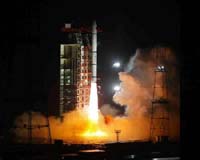
Xichang - Apr 19, 2004 China successfully sent two new satellites into space early Monday with a Long March II C carrier rocket. The rocket was launched at 11:59 p.m. Sunday at the Xichang Satellite Launch Center based in southwest China's Sichuan Province. The launch indicated a technological breakthrough in the country's development of small satellites, Chinese space scientists said. The two satellites will be used for scientific experiments. About a dozen minutes after lift-off, the carrier rocket first released the "Experiment Satellite I" and then "Nano-satellite I" 30 seconds later. Data from the Xi'an Satellite Monitoring and Control Center showed that the satellites were orbiting as designed and the launch was a success. The Experiment Satellite I, with a weight of 204 kg, is China's first transmission-type small satellite capable of stereo mapping. It was jointly designed by the Harbin Polytechnic University, Chinese Research Institute of Space Technology, Changchun Photomechanical Institute of the Chinese Academy of Sciences (CAS)and Xi'an Surveys and Designs Institute. The experiment satellite will mainly be used to carry out photographic surveys of China's land resources, monitor geographical environment and conduct scientific research on mapping. It will be handed over for use to the Satellite Remote-Sensing Ground Station of CAS following the satellite's orbit testing. Nano-satellite I, with a weight of 25 kg, is designed for high-tech experiments. The satellite was developed and will be used by the elite Qinghua University and the Aerospace Qinghua Satellite Technologies Co. Ltd. The Long March II C carrier rocket was developed by the China Institute of Carrier Rocket Technology. The latest launch was the 76th flight of Long March carrier rockets and the 34th successful launch in a row since October 1996. Source: Xinhua News Agency Community Email This Article Comment On This Article Related Links SpaceDaily Search SpaceDaily Subscribe To SpaceDaily Express The Chinese Space Program - News, Policy and Technology China News from SinoDaily.com
 Taikonauts On Moon A Far Off Dream For China Yet
 Beijing (XNA) Jan 05, 2006
A one-year lunar fly-by mission may start in April 2007 in China, but a manned flight to the Earth's neighbour may be a long way away, a chief lunar exploration scientist said last night. |
|
|

| The content herein, unless otherwise known to be public domain, are Copyright 1995-2006 - SpaceDaily.AFP and UPI Wire Stories are copyright Agence France-Presse and United Press International. ESA PortalReports are copyright European Space Agency. All NASA sourced material is public domain. Additionalcopyrights may apply in whole or part to other bona fide parties. Advertising does not imply endorsement,agreement or approval of any opinions, statements or information provided by SpaceDaily on any Web page published or hosted by SpaceDaily. Privacy Statement |