|
 |
 |
 |
 |
 |
 |
 |
 |

 |
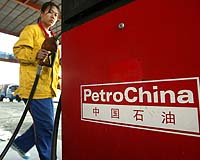
China's Government Squares Off With State Oil Companies Over Gasoline Prices
Shanghai (AFP) Aug 17, 2005 The Chinese government and its state-owned oil companies are locked in battle over artificially low gasoline prices at the pump that has caused a massive shortage in the southern manufacturing province of Guangdong, analysts said Wednesday. For weeks skyrocketing global oil prices and rising demand has led to a fuel-supply crunch as domestic refineries have been caught short in Guangdong. Some fear it is only a matter of time before gas-guzzling cities such as Shanghai are hit too. The government has blamed recent stormy weather for the shortfall, which is feasible but not enough to result in the kilometre long queues at filling stations that drivers in Guangdong have endured for nearly a month. As oil prices climbed, a standoff erupted between China's National Development Reform Commission (NDRC) - a key economic policy planning body - and the country's two largest state oil groups PetroChina and Sinopec, analysts said. The crisis highlights the persistent problems Beijing faces as the economy is transformed to a more market-based system but that is often retarded by authorities who fear loosing political control in the face of full-fledged capitalist rules. "The extent of the market orientation in China's economy is not enough ... which leads to lots of contradictions in China's economy," said He Jun, an expert at Anbound, a government and private sector energy and economic consultancy. In China, oil prices are set under a quasi-market system. The government fixes oil prices with reference to the previous month's global trading levels in New York, Rotterdam and Singapore and then allows the price to float within eight percent of daily trade. But as prices soared to 67 dollars a barrel on international markets Sinopec and PetroChina dug in their heels, refusing to supply refineries with imported oil that is as much as 20 US dollars per barrel more expensive than domestic prices. "It is not reasonable to blame the two companies," said Qian Xiaoyu, an analyst from Shenzhen-based United Securities. "The oil panic is the evil result of government-controlled oil prices in China. It is an example of the failure of government-controlled prices." Oil prices in China currently range between 43 to 47 dollars a barrel depending on the province, with each provincial NDRC branch setting the price. "The companies can't just boldly tell the government that they are not doing business any more," said Qian. "What they can do is to not take the initiative to refine more oil, or to raise supply." Sinopec Guangdong Corp, a branch of Sinopec group, insisted it was still operating at full capacity but urged action be taken. "As soon as possible the pricing system of domestic oil products must be straightened out and the synchronisation between the adjustment of domestic and international oil prices improved," Xinhua news quoted the company as saying. It warned that otherwise "the imbalance between demand and supply will be more severe." The NDRC in Guangdong refused to comment. Despite calling the government's pricing system "stupid" Anbound's He squarely placed the blame on China's two largest domestic oil groups. "Sinopec and China National Petroleum Corp (PetroChina) are responsible for the oil panic. "The companies should have expectations and estimate market demand in order to guarantee stable supply, but they are not taking the initiative to increase supply because they are losing money," He said. Amid the fierce finger pointing that has marked several recent Chinese editorials, the crisis goes to the heart of government worries about China's hybrid economic system. "For the NDRC this a monetary policy issue, if they raise gasoline prices inflation will go up and then they have to raise interest rates," said Alan Chan, oil analyst at KGI Asia in Hong Kong. "It is an issue that is extremely hard to resolve," said Chan. Community Email This Article Comment On This Article Related Links SpaceDaily Search SpaceDaily Subscribe To SpaceDaily Express China News from SinoDaily.com
 China Wants To Expand Sino-US Military Relations
 Beijing (AFP) Jan 10, 2006
China is ready to expand its military relations with the United States, Chinese Defense Minister Cao Gangchuan said on Tuesday. |
|
|

| The content herein, unless otherwise known to be public domain, are Copyright 1995-2006 - SpaceDaily.AFP and UPI Wire Stories are copyright Agence France-Presse and United Press International. ESA PortalReports are copyright European Space Agency. All NASA sourced material is public domain. Additionalcopyrights may apply in whole or part to other bona fide parties. Advertising does not imply endorsement,agreement or approval of any opinions, statements or information provided by SpaceDaily on any Web page published or hosted by SpaceDaily. Privacy Statement |