|
 |
 |
 |
 |
 |
 |
 |
 |

 |
Chinas Cancer Villages Pay Heavy Price For Economic Progress
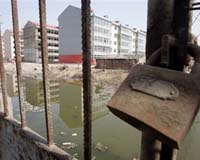
Liukuaizhuang Village, China (AFP) May 09, 2006 Sitting on his bed in his spartan house in one of China's so-called cancer villages, a 77-year-old retired cadre sheds tears as he speaks of the pollution he believes is killing him. "I just hope I can die sooner. I gave my life to the Communist Party yet I have nothing now, I have nothing to leave to my own children," the man said, tears rolling down his cheeks. The man, who requested anonymity out of fear of government reprisals, was diagnosed with lung cancer several years ago, which he believes was caused by years of breathing in the local chemical-filled air and drinking contaminated water. The man lives in Liukuaizhuang village which, along with neighboring Xiditou village in Tianjin municipality 120 kilometers (75 miles) southeast of Beijing, rose from poor areas into economic "successes" after scores of chemical factories moved in two decades ago. But the industry that brought the villages wealth and employment also ended up destroying the environment and is widely believed to have ultimately cost the health and lives of many residents. Locals say over 200 residents in the two villages have been diagnosed with diseases including bone, lung, liver and breast cancers, while a handful of children are suffering from leukemia. A report on the People's Daily website, quoting Tianjin health authorities, said the rates of cancer in Liukuaizhuang and Xiditou were 1,313 and 2,032 per 100,000 people, way above the national average of 70 per 100,000 people. According to the report, high levels of bacteria, fluoride and cancer-causing hydroxybenzene that exceeded government limits have been found in Liukuaizhuang's water. Even after the government ordered scores of polluting factories to close and declared the local water safe enough to drink, smaller factories continue to operate secretly as local officials turn a blind eye, villagers say. Residents say they are simply helpless to fight the factories or seek compensation as they have no legal recourse. Xu Kezhu, from the China Politics and Law University's Environmental Pollution Victim Support Center, said the group had been trying to help residents sue factories but none of the cases had been accepted by the courts. Despite receiving national media attention, the lack of evidence remains a problem as local government officials pressure doctors into staying silent over the link between pollution and the high cancer rate, villagers say. Factory owners and wealthier residents have mostly moved out of the area, yet for those who are too poor to move, everyday is just another depressing reminder that pain and death are never far away. Liang Shuli, a Xiditou resident whose five-year-old son was diagnosed with leukemia, said villagers had no choice but to suffer. "There is no way out for us, we are still drinking that water," Liang said. "Where do we get the money to buy mineral water?" Another resident from Xiditou, Li Baoqi, whose wife had recently been diagnosed with liver cancer, agreed. "If you get the disease, you are just waiting to die," he said. Another villager who only wanted to be identified by his surname of Lui was one of the luckier ones as he could afford to move his family to escape the chronic pollution and only comes home occasionally. "This is the river where we used to swim as boys," sighed Lui, looking behind his backyard to the waterway that is now clogged up with industrial waste. "Our village used to be known as the home to fish and rice -- now look at it." Reports of "cancer villages" have become increasingly frequent across China, a brutal legacy of the environmental and health woes that have accompanied the nation's past 25 years of economic growth. Xu said her center alone was dealing with 70 such cases, although she was unable to provide statistics on how many villages across China had been similarly affected. In Liukuaizhuang, with unemployment high amid economy stagnation following the closures of the chemical factories, locals are left to lament on the false dawn that China's industrial reforms brought them. "Before, you were poor but you had health. And health surely is the most precious thing," Lui said.
Source: Agence France-Presse Community Email This Article Comment On This Article Related Links - Our Polluted World and Cleaning It Up
 China Says River Clean After Thaw
 Beijing (AFP) May 09, 2006
Melting ice has not caused a second wave of pollution in China's Songhua River following a major chemical leak last year, the nation's environmental watchdog said Monday. |
|
|

| The content herein, unless otherwise known to be public domain, are Copyright 1995-2006 - SpaceDaily.AFP and UPI Wire Stories are copyright Agence France-Presse and United Press International. ESA PortalReports are copyright European Space Agency. All NASA sourced material is public domain. Additionalcopyrights may apply in whole or part to other bona fide parties. Advertising does not imply endorsement,agreement or approval of any opinions, statements or information provided by SpaceDaily on any Web page published or hosted by SpaceDaily. Privacy Statement |