|
 |
 |
 |
 |
 |
 |
 |
 |

 |
China, Brazil To Launch 3 Earth Resources Satellites In Coming Years
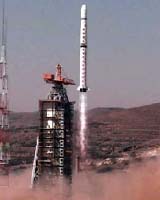
Beijing (XNA) Oct 15, 2004 China and Brazil plan to launch three satellites in the coming few years to gather information on the Earth's environment, agriculture, urban development planning and water pollution, said Sun Laiyan, director general of the China National Space Administration (CNSA), last Friday. The launches include satellite 02B, 03 and 04 of Sino-BrazilianEarth Resource Satellite series. Satellite 02B will be similar to the two satellites the two countries have developed in the past 17 years. China launched the two satellites, or satellite 01 and 02, which were developed by Chinese and Brazilian scientists, into preset orbits in 1999 and 2003 atop Chinese-made Long March 4B rockets. Satellite 01 was in orbit for approximately 4 years, nearly double its designed life span of two years. It has been replaced with Satellite 02. Space administrations from the two countries Friday agreed to launch an extra satellite, or Satellite 02B, in 2006 to replace Satellite O2, which also has a designed life span of two years. The plan on Satellite 02B is expected to be approved by top leaders of the two countries who are scheduled to meet in Brazil next month, said the Chinese space official. The success of the two country's development of the earth resources satellites 01 and 02 was lauded by the two countries as a milestone. Prior to this, the two countries did not have their own transmission-type resources satellites and had to rely on a third country for satellite images of the Earth's environment, agriculture, urban planning and water pollution, noted Sun. Luis Manuel Rabelo Fernandez, Brazilian vice-minister of Science and Technology, said the satellite cooperation program is of "strategic importance" for the Brazilian government. "It is an example to the world of what can be achieved by two developing countries through active and long-term cooperation in afrontier field of high and complex technology, " he said. Guo Jianning, director general of China Center for Resources Satellite Data & Application, acknowledged that satellite images from the two satellites China and Brazil launched have are being used for agriculture, forestry, land, mineral sources, water conservancy, mapping, environmental protection, disaster monitoring and urban planning. Organizations and firms from other countries, including Iran, Egypt, Malaysia, Canada and Nigeria have expressed their intentionof buying the satellite image products from China or Brazil, said the official. Chinese and Brazilian space officials have reached a consensus on sales of their satellite image products to third countries, andare awaiting approval from their leaders. Shortly after the two countries produced images via satellites,similar products marketed by overseas companies dropped by half onthe Chinese market. Brazil put about 30,000 pieces of satellite images on the Internet free of charge for their domestic users, capturing almost the whole domestic market that used to be dominated by overseas products. China and Brazil have set up a trans-departmental organization recently to coordinate their cooperation in space technology. The organization met Thursday for the first time in Beijing. The organization, known as the Chinese and Brazilian Space Technology Cooperation Commission, is co-chaired by Chinese minister of the State Commission of Science, Technology and Industry for National Defense, and Brazilian minister of Sciences and Technology. But officials from China's ministries of foreign affairs, finance, commerce, space administration and space technology companies are on the commission, while officials from Brazilian ministries of foreign affairs, defense, finance and space administration are part of the commission. According to a communique signed in May by visiting Brazilian President Lula and Chinese President Hu Jintao, they are satisfiedwith the progress their countries have made in the resources satellite program, and the two countries will continue, and expandtheir cooperation in the application of remote sensing technology,and provide related satellite application services. Source: Xinhua News Agency CommunityEmail This Article Comment On This Article Related Links SpaceDaily Search SpaceDaily Subscribe To SpaceDaily Express Earth Observation News - Suppiliers, Technology and Application
 New Legislation Initiated To Support Commercial Remote Sensing Industry
 New York NY (SPX) Jan 11, 2006
The importance of remotely sensed data and technologies to support natural disasters has prompted attention and action in Washington. New initiatives and legislation authorizing appropriations to the remote sensing industry will be discussed at Strategic Research Institute's U.S. Commercial Remote Sensing Industry conference, scheduled for February 9-10, 2006 in Washington D.C. |
|
|

| The content herein, unless otherwise known to be public domain, are Copyright 1995-2006 - SpaceDaily.AFP and UPI Wire Stories are copyright Agence France-Presse and United Press International. ESA PortalReports are copyright European Space Agency. All NASA sourced material is public domain. Additionalcopyrights may apply in whole or part to other bona fide parties. Advertising does not imply endorsement,agreement or approval of any opinions, statements or information provided by SpaceDaily on any Web page published or hosted by SpaceDaily. Privacy Statement |