|
 |
 |
 |
 |
 |
 |
 |
 |

 |
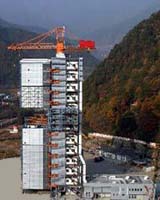
China Upgrades Satellite Launch Tower
Beijing (XNA) Jan 03, 2007 A launch tower at a major satellite launch center in southwest China has been upgraded to increase the country's satellite launch competitiveness. Use of the No. 3 tower at the Xichang Satellite Launch Center in Sichuan Province would alternate with the No.2 tower and it was possible that two rockets could be erected simultaneously, a center spokesman said. The upgrade will improve China's launching competitiveness in the international arena, the spokesman said. In the next five years, the Xichang center would develop the capability to launch more than 10 satellites a year, the spokesman said. Set up in 1983, the No. 3 tower is mainly used to launch geosynchronous satellites on Long March-3 carrier rockets and polar orbit satellites on Long March-2C rockets. It has successfully launched 16 satellites, including China's first experimental communications satellite Dongfanghong-2. New technologies such as remote control, a real-time three-dimensional display system and a low-temperature fuel concentration warning system were introduced to the upgraded launch tower, making it more advanced, highly-automated and safer, the spokesman said. The Xichang Satellite Launch Center was established in 1970. It will launch China's first lunar-probing satellite in 2007.
Source: Xinhua News Agency Community Email This Article Comment On This Article Related Links Read More About the Chinese Space Program Launch Pad at Space-Travel.com The Chinese Space Program - News, Policy and Technology China News from SinoDaily.com
 China Reports Breakthrough In Space Determination And Control Technology
 Beijing (XNA) Jan 03, 2007
China recently reported breakthroughs in space tracking and control technology. Projects to develop sophisticated spacecraft orbit computing technology and USB-VLBI moon orbit determination testing and verification technology were undertaken by Xi'an Satellite Monitoring and Control Center, and recently passed an assessment by a panel of experts from China's space authority. |
|
|

| The content herein, unless otherwise known to be public domain, are Copyright 1995-2006 - SpaceDaily.AFP and UPI Wire Stories are copyright Agence France-Presse and United Press International. ESA PortalReports are copyright European Space Agency. All NASA sourced material is public domain. Additionalcopyrights may apply in whole or part to other bona fide parties. Advertising does not imply endorsement,agreement or approval of any opinions, statements or information provided by SpaceDaily on any Web page published or hosted by SpaceDaily. Privacy Statement |