|
 |
 |
 |
 |
 |
 |
 |
 |

 |
China To Send Pig 'Eggs' Into Space
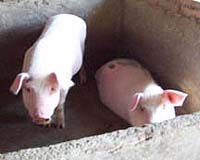
Beijing (AFP) Jul 17, 2005 China plans to take 'eggs' from pedigree pigs on its second manned space mission to study whether exposure to outer space alters the genetic make-up of the 'eggs', state media said Sunday. Some 40 grams of pig 'eggs' will be carried on board the spacecraft Shenzhou VI when it blasts off in early October, the Xinhua news agency said. The 'eggs' will come from two carefully selected "Rongchang" pigs, which are named after Rongchang county in southwest China's Chongqing municipality. The pigs are considered outstanding in terms of their physique and the quality of their pork, Xinhua said. Some 'eggs' will be kept inside the capsule of the Shenzhou VI and some will be stored outside it, enabling scientists to study the impact of microgravity and cosmic rays on the samples. After four or five days in space, the 'eggs' will be brought back to earth and used to fertilise pig eggs in test-tubes. The procedure will be conducted by the Chongqing Academy of Animal Husbandry Science. Two astronauts will circle the earth for five to six days during the space flight - only China's second manned space mission after Shenzhou V's successful launch in late 2003, which lasted 21 hours. China is only the third country after Russia and the United States to launch its own manned space flights. Editor's Note: Due to nanny state software we have changed the original word used to describe 'eggs' to ensure that this story does not jam up the newsletter or the website as it distributed or downloaded. Community Email This Article Comment On This Article Related Links SpaceDaily Search SpaceDaily Subscribe To SpaceDaily Express The Chinese Space Program - News, Policy and Technology China News from SinoDaily.com
 Taikonauts On Moon A Far Off Dream For China Yet
 Beijing (XNA) Jan 05, 2006
A one-year lunar fly-by mission may start in April 2007 in China, but a manned flight to the Earth's neighbour may be a long way away, a chief lunar exploration scientist said last night. |
|
|

| The content herein, unless otherwise known to be public domain, are Copyright 1995-2006 - SpaceDaily.AFP and UPI Wire Stories are copyright Agence France-Presse and United Press International. ESA PortalReports are copyright European Space Agency. All NASA sourced material is public domain. Additionalcopyrights may apply in whole or part to other bona fide parties. Advertising does not imply endorsement,agreement or approval of any opinions, statements or information provided by SpaceDaily on any Web page published or hosted by SpaceDaily. Privacy Statement |