|
 |
 |
 |
 |
 |
 |
 |
 |

 |
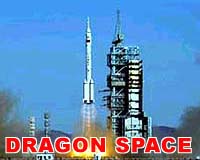
China To Launch Two Astronauts Next Year
Beijing - Jun 04, 2004 China will send at least two astronauts into outer space in the fall next year, and they will stay there for at least one week, reported Thursday's The Beijing News, citing Yang Jiachi, academician of the Chinese Academy of Sciences (CAS). Yang made the remarks at an ongoing conference of academicians organized jointly by the CAS and the Chinese Academy of Engineering (CAE) from June 2 to 6 in Beijing. The astronauts will move between the re-entry module and orbital module, two parts of the spaceship, when they are in outer space, according to Yang, who described it as the "biggest" breakthrough for this manned space mission. "Possibly, Yang Liwei may not be chosen for this mission," Yang said. China followed in the footsteps of the Soviet Union and the United States to achieve manned space flight last October, when astronaut Yang Liwei orbited the earth 14 times. However, the detailed plan, such as exactly how many astronauts will be sent into space and how long they will stay there, is yet to be decided and China is still conducting relevant experiments, noted Yang. China has actually found out a technical solution for sending a few astronauts into space at one time, Yang said. The key issue isabout the safety and reliability of relevant equipment, which could not ensure a 100 percent safe mission so far. "Many problems cannot be easily checked out after the spaceshipis launched into space," Yang acknowledged. "What's more, what we are sending are real human beings, so we must be most careful." Yang said scientists always act as a "psychological tutor" in participating in the selection of spacemen, like encouraging them to be fully confident. A Long March II F carrier rocket will still be used to launch the space flight and the design of the Shenzhou VI will basically remain the same as that of the Shenzhou V. And the astronauts will step into the orbital module and conduct various types of experiments there, according to Yang. Yang, 85, was one of the initiators of China's "863 High-Tech Program" and also academician of the International Academy of Astronautics (IAA). Source: Xinhua News Agency Community Email This Article Comment On This Article Related Links SpaceDaily Search SpaceDaily Subscribe To SpaceDaily Express The Chinese Space Program - News, Policy and Technology China News from SinoDaily.com
 Taikonauts On Moon A Far Off Dream For China Yet
 Beijing (XNA) Jan 05, 2006
A one-year lunar fly-by mission may start in April 2007 in China, but a manned flight to the Earth's neighbour may be a long way away, a chief lunar exploration scientist said last night. |
|
|

| The content herein, unless otherwise known to be public domain, are Copyright 1995-2006 - SpaceDaily.AFP and UPI Wire Stories are copyright Agence France-Presse and United Press International. ESA PortalReports are copyright European Space Agency. All NASA sourced material is public domain. Additionalcopyrights may apply in whole or part to other bona fide parties. Advertising does not imply endorsement,agreement or approval of any opinions, statements or information provided by SpaceDaily on any Web page published or hosted by SpaceDaily. Privacy Statement |