|
 |
 |
 |
 |
 |
 |
 |
 |

 |
China To Launch Rapid-Response, Mobile Rocket, Nanosatellite Next Year
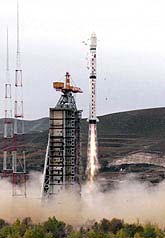
Shanghai - May 1, 2001 The People's Republic of China is making rapid progress with the development of its first all-solid propellant small satellite launcher, according to Yin Xingliang, Vice President of China Aerospace Machinery and Electronics Corp. (CAMEC), during a space symposium held here from 17-20 April. The symposium, jointly organized by the Chinese Society of Astronautics (CSA) and the Paris-based International Academy of Astronautics (IAA) brought together some 150 experts from China, Germany, France, Russia, the USA and other countries gathered to discuss the economics of space flight and ways of bringing the benefits of space technology down to earth. Hosted by the Shanghai Academy of Space Flight Technology (SAST), the meeting was addressed by ranking space agency and industry officials, including Prof. Luan Enjie, Administrator of the Chinese National Space Administration (CNSA); Prof. Jin Zhuanglong, President of SAST; Mr. Alain Bensoussan, President of the French Space Agency (CNES) and chairman of the ESA Council; and Dr. Jean Michel Contant, IAA Secretary General and head of marketing and commercial planning of EADS Launch Vehicles Company in Les Mureaux, France. In his opening address, the president of SAST hailed the practical approach of the Chinese space programme and said that, thanks to communication satellites, "China has already established the national satellite communication system, the national satellite television education system, the national TV and broadcasting system, the long-distance medical system and a large number of VSAT applications." Other satellites serving the country's needs included weather satellites for short- and long-term forecasting, the prevention of disasters ; remote sensing satellites to provide for sustainable economic development and recoverable satellites, "which have made it possible to develop wheat, rice and vegetables with high yields and quality". To continue along this road, China is to launch a unique "Seeds Satellite" early next year.
Prof. Guo Baozhu, CNSA Vice Administrator said that under the 10th five-year plan, China's space industry would give particular emphasis to seven areas:
"During the next five years, China will also launch two optical earth resources satellites and one radar satellite," with more being planned, Guo said. Rapid-reaction system, 10-kilo microsatellite to be tested next year According to Yin Xingliang, Vice President of CAMEC, a company created from the former China Aerospace corp., and President of its Second Academy (CCF), there is a need for 300-500 kg class satellites to be put into orbit "within hours upon request from a customer" in order to monitor and manage disasters such as forest fires, floods and marine pollution, along with "scientific, economic and national security needs". To this end, "CAMEC is developing a solid-propellant launch vehicle with a capacity to get into working state rapidly" and which could be launched from a mobile, truck-based platform, "anywhere in the country". "This launch vehicle requires to be modulized and serialized and be suitable for different payloads and orbit requirements," Yin said. "In addition, the launch vehicle must be produced in sufficient numbers in order to be put into operation rapidly." The satellite must be able to be put into operation during the first orbit circle and be able to interact with ground stations as soon as possible. To that end, "the tracking, telemetry and command method and the TT&C system must conform to features of mobile launch". Development of the launcher is "in progress" and the vehicle could be tested as early as next year, Yin said. Chinese speakers also devoted much attention to new nano- and picosatellites now under development by Tsinghua and Harbin universities and their commercial spinoffs, in collaboration with foreign partners including Surrey University in Britain and the former Dornier Company, now Astrium, in Friedrichshafen, Germany. TS-1, a 150-kg microsatellite with a 10-meter stereo resolution observation capacity is being developed with input from Astrium, according to Dr. Zhang Yingchun of the Harbin Institute of Technology (HIT). Dr. Zhang Xiaomin, of Tsinghua University Space Center (TSC), discussed the success of the 50-kg Hangtian Tsinghua-1 microsatellite which was jointly developed with CAMEC and Surrey Space Center (SSC) and has been in orbit since June 2000, providing ground pictures with a resolution of 40 meters. Hailing the work of non-governmental entities, he said his institute was working on three nanosatellites, including a 10-kg MEMS technology test platform, to be launched in 2002, along with a 50-kg and a 100-kg nanosatellite, the latter to be developed jointly with Surrey. Also under development, according to Zhang, is a 1-kg picosatellite. In another noteworthy development, Mr. Philippe Couillard, President and CEO of EADS Launch Vehicle Company in France, expressed regrets that "China is not participating in the international space station as a space power", but "if your nation confirms its ambitions towards manned space flight, it is conceivable that such cooperation will be possible in the future. "As a European, I would be very open to any China-Europe cooperation that might develop initially, specifically out of the ISS." Thanks to Ariane-5 and the European Automatic Transfer Vehicle, Couillard said, "Europe is able to send freight to the ISS. Could not something be built along this idea?" Chinese speakers, including Tsinghua University's Dr. Zhang also expressed interest in finding ways to participate in the International Space Station (ISS), proposing the development of a "companion" (free flyer) satellite "with a mass no more than 100 kg" to carry out small experiments as a means of performing microgravity experiments, testing new technologies and providing a means of entering cooperation with the ISS "without changing its program or mission". Community Email This Article Comment On This Article Related Links SpaceDaily Search SpaceDaily Subscribe To SpaceDaily Express The Chinese Space Program - News, Policy and Technology China News from SinoDaily.com
 Taikonauts On Moon A Far Off Dream For China Yet
 Beijing (XNA) Jan 05, 2006
A one-year lunar fly-by mission may start in April 2007 in China, but a manned flight to the Earth's neighbour may be a long way away, a chief lunar exploration scientist said last night. |
|
|

|
|
|
|
|
|
|
|
|
|
|
|
| The content herein, unless otherwise known to be public domain, are Copyright 1995-2006 - SpaceDaily.AFP and UPI Wire Stories are copyright Agence France-Presse and United Press International. ESA PortalReports are copyright European Space Agency. All NASA sourced material is public domain. Additionalcopyrights may apply in whole or part to other bona fide parties. Advertising does not imply endorsement,agreement or approval of any opinions, statements or information provided by SpaceDaily on any Web page published or hosted by SpaceDaily. Privacy Statement |