|
 |
 |
 |
 |
 |
 |
 |
 |

 |
China To Build World's Largest Radio Telescope
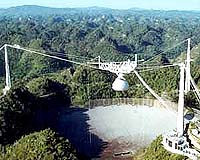
Beijing, China (XNA) Nov 23, 2006 China has officially started the feasibility study on the construction of a 500 meter aperture spherical telescope (FAST), which will be the largest in the world. Senior officials from the National Development and Reform Commission, the country's top planning body, visited the proposed site of the project, a karst depression in Pingtang county, Guizhou Province in southwest China last week, the NDRC said on its website. Officials and experts from NDRC, the Chinese Academy of Sciences (CAS), the National Astronomical Observatory, the Guizhou Province and other related departments then discussed the projects at a conference in Guiyang, the capital of Guizhou. FAST is among China's top nine mega facilities for science and technology research, the website says. According to an earlier report by Science Times, a newspaper published by CAS, FAST's main spherical reflector will be composed of 4,600 panels and occupy an area as large as 25 football fields. Nan Rendong, the chief scientist of the project and a researcher with the National Astronomical Observatory, was quoted by the newspaper as saying FAST's observation capacity will be 10 times over that of the world's current biggest steerable radio telescope, with a 100-meter aperture. Scientists have so far observed only 1,760 pulsars. With the help of FAST, they would be able to find as many as 7,000 to 10,000 of them in a mere one year, he said. Moreover, FAST could also work as a highly sensitive passive radar for the monitoring of satellites and space debris, which would be greatly helpful for China's ambitious space program, he said. The FAST concept was first proposed in 1994. Chinese scientists have since then been working on the projects. They have successfully built a prototype of the main reflector and have almost completed the designing and testing of the feed support system, said another report by the Beijing Review, a weekly English publication. If the feasibility study could be completed on time, FAST might be put into use by 2013, said Nan Rendong.
Source: Xinhua News Agency Community Email This Article Comment On This Article Related Links Chinese Academy of Sciences All about the technology of space and more Space Telescope News and Technology at Skynightly.com
 New Telescope Helps Scientists Track Down Threats To Planet Earth
 Beijing, China (XNA) Nov 23, 2006
China has built a new Schmidt telescope, the largest of its kind in China, to keep track of near-earth objects (NEO) that could threaten Planet Earth. The telescope, measuring one meter in diameter, has been tested in a branch observatory belonging to Mount Zijin Observatory under the Chinese Academy of Sciences, in east China's Jiangsu Province. |
|
|

| The content herein, unless otherwise known to be public domain, are Copyright 1995-2006 - SpaceDaily.AFP and UPI Wire Stories are copyright Agence France-Presse and United Press International. ESA PortalReports are copyright European Space Agency. All NASA sourced material is public domain. Additionalcopyrights may apply in whole or part to other bona fide parties. Advertising does not imply endorsement,agreement or approval of any opinions, statements or information provided by SpaceDaily on any Web page published or hosted by SpaceDaily. Privacy Statement |