|
 |
 |
 |
 |
 |
 |
 |
 |

 |
China Talks Tough As US Arms Control Expert Arrives For Talks
Moscow (AFP) July 6, 2000 The United States' top arms control negotiator arrived in Beijing on Thursday as China talked tough over NATO's bombing of its Belgrade embassy and US plans for missile defence shields. Undersecretary of State for Security and Arms Control John Holum made no comment to reporters as he entered his hotel in the Chinese capital. His visit is aimed at paving the way for the full resumption of non-proliferation talks -- broken off after the May 7, 1999 embassy bombing. Chinese foreign ministry spokesman Sun Yuxi welcomed the visits by Holum and US Defense Secretary Willian Cohen next week, saying they were important for maintaining a healthy relationship between the two sides. "They not only serve the fundamental interests of the two countries but are also very important and of far reaching significance for maintaining regional and global interests," he said. But the spokesman went on to criticise the United States over the bombing of the embassy in Yugoslavia and Washington's proposed National Missile Defense (NMD) system and its propsed Theatre Missile Defense (TMD) system with Japan. "We are still demanding that the US side face the severity of this bombing incident and carry out a full investigation into this matter leading to a satisfactory explanation," he said. The bombing, which killed three and injured some 20 embassy staff, "was a gross violation of Chinese sovereignty, greatly hurt the feelings of the Chinese people and undermined China-US relations." The visit by Cohen is the first visit by a US defense secretary since the bombing, which the United States has called a "tragic mistake" and paid 32.5 million dollars in compensation. It follows a visit by US Secretary of State Madeleine Albright to Beijing last month. During the talks the United States is expected to raise objections to the sale of weapons and missile technology to Iran and Pakistan, while China will object to US weapons sales to Taiwan, diplomats said. The United States is also expected to outline its hopes of amending the 1972 Anti-ballistic Missile (ABM) Treaty signed between Washington and Moscow, a move deemed necessary to clear the United States of its international obligations to refrain from developing new missile systems. "Regarding the missile defense plan we believe it is against the trend of the times and is not conducive to the international disarmament and arms control efforts and will have a negative impact on the global and regional strategic balance and stability," Sun said. A proposed joint US-Japan theater missile defense system will "dramatically raise the legitimate defense needs" of other countries in the region and undermine peace and security in the Asian region. "If any country would like to include Taiwan in a TMD system that will constitute a gross violation of China's sovereignty and territorial integrity and shall meet with the strong opposition of the Chinese side," he added. Sun further reiterated China's support for Russian opposition to amending the AMB Treaty, saying "the two sides have already started cooperation in this regard and will continue to intensify cooperation in further maintaining the strategic balance in the world." With the resumption of Sino-US security and arms control talks and high-level military exchanges, now all that is lacking between the two countries is the resumption of their human rights dialogue. "Its our belief that the responsibility for the break down of the human rights dialogue does not lie with the Chinese side, we hope the United States will take concrete actions to enable us to resume," Sun said.
|
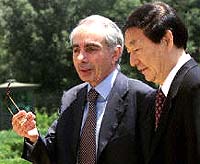
Rome (AFP) July 6, 2000 - Italy and China on Thursday warned against boosting military expenditure to a point where it would threaten the 1972 Anti-Ballistic Missile Treaty and relations between nations. Speaking after talks with Chinese Prime Minister Zhu Rongji, Italian Prime Minister Giuliano Amato said they had agreed that "some countries pose a threat but it is essential that risks be reduced." Zhu said China was "categorically opposed" to a US shield against ballistic missiles because it would also "aim to absorb Taiwan into the American sphere of protection, which we consider a gross interference into China's domestic affairs." Amato said Italy and China were acknowledging US caution in handling the missile shield issue. The US missile shield project may be cause for concern because it could be perceived "as a threat rather than a means of defense," he added. Reiterating Beijing's position of "one country, two systems", Zhu said that, in line with a policy already applied to Hong Kong and Macau, China could propose Taiwan a separate system, "even a more generous one," after unification with the mainland. He cited a renunciation to send Chinese troops to Taiwan as an example of this separate status. Taiwan would also be represented in the central government. China has sent troops to Macau, Zhu recalled. "But after reunification we need not send troops to Taiwan," he added. As another generous offer, Beijing could also propose a central government post to Taiwan. "Unfortunately Taiwan leaders do not behave like the leaders of the two Koreas; they don't even acknowledge being Chinese," he said. Amato and Zhu also pledged closer cooperation to stem organized crime and illegal immigration from China to prevent disasters like the one which cost the lives of 58 stowaways in a container truck trying to enter Britain last month. Italian anti-Mafia police have warned that the the trade in Chinese immigrants was becoming more and more organised, employing the use of speedboats to bring asylum seekers across the northern Adriatic from Croatia. Smugglers were using the new route after Italy tightened controls on its southern coast. "China is strongly opposed to illegal immigration," Zhu said. "But to fight it we need more international cooperation and a joint effort." Amato also warned that the effects of globalisation were helping organised crime. Zhu, on his fourth visit to Italy, arrived in Rome late Wednesday for a four-day visit focusing on economic and political issues. The visit comes as the two countries mark the 30th anniversary of diplomatic relations. Zhu, who said he had no plans for a visit to the Vatican, invited Amato to come to China in November. The two leaders also touched on human rights issues, a subject which had played a prominent part in talks between Chinese President Jiang Zemin and Italian leaders in Rome in March last year. Amato reiterated his government's position that it is "opposed to capital punishment in all countries, and not in one in particular." Zhu warned against creating "antagonisms" over the human rights issue and added that it was "up to the Chinese government" to decide whether or not to abolish the death penalty. Human rights activists had protested Jiang's visit last year, with then-Italian president Oscar Luigi Scalfaro calling for "more rapid progress" on democracy measures. But there were no sign of protests in Rome Wednesday or Thursday. Zhu was to have a meeting with Italian business leaders later Thursday. On Friday he was to visit Pisa and Florence before traveling to Venice Saturday. He will wind up his European tour in Brussels where he was expected Sunday. |
 Memory Foam Mattress Review |
Newsletters :: SpaceDaily :: SpaceWar :: TerraDaily :: Energy Daily XML Feeds :: Space News :: Earth News :: War News :: Solar Energy News |
 Satellite Launch To Boost DTH In India
 Calcutta, India (SPX) Dec 28, 2005
|
|

|
|
|
|
|
|
|
|
|
|
|
|
| The content herein, unless otherwise known to be public domain, are Copyright 1995-2006 - SpaceDaily.AFP and UPI Wire Stories are copyright Agence France-Presse and United Press International. ESA PortalReports are copyright European Space Agency. All NASA sourced material is public domain. Additionalcopyrights may apply in whole or part to other bona fide parties. Advertising does not imply endorsement,agreement or approval of any opinions, statements or information provided by SpaceDaily on any Web page published or hosted by SpaceDaily. Privacy Statement |