|
 |
 |
 |
 |
 |
 |
 |
 |

 |
China Seeks Russian Help With Own Space Station
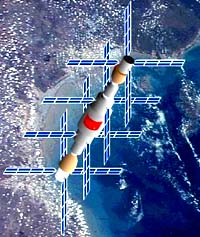
Beijing - March 7, 2000 - Russia has started a serious dialogue with China to assist its communist neighbour in building its own space station, Russian Deputy Prime Minister Ilya Klebanov said last week in a report by ITAR-TASS. "We have very seriously talked with our Chinese friends about the use of our technologies in the creation of an orbiting manned stations," ITAR-TASS quoted Klebanov as saying. "They are interested in our participation, we are also interested in passing on our experience". Klebanov, who is responsible for the military-industrial complex in the Russian government, led a delegation of ministers in a three-day visit in Beijing. Among the accompanying ministers was the Russian Space Agency Director Yury Koptev. The delegation discussed a broad range of issues with their Chinese counterparts on strategic and technical cooperation, including the peaceful exploration of space, and a strengthening of trade and economic relations. The visit paved the way for a Sino-Russian presidential summit scheduled for this summer. Xinhua News Agency and People's Daily did not report the news of the discussion. The coverage of the Russian delegation visit was overshadowed by news from the Ninth National Committee of the Chinese People's Political Consultative Conference, an annual legislative session which opened here last Friday (Mar. 4). A week ago ITAR-TASS quoted a report from the Spanish news agency EFE that China might spend several billion dollars to purchase the aging Mir space station. ITAR-TASS subsequently reported that Beijing reacted to the offer "sluggishly", and the Russian Aviation and Space Agency (Rosaviakosmos) responded to the report as "absolutely groundless". Klebanov's words echoed the comment of former Russian cosmonaut Anatoli Filipchenko. In an interview with the Japanese economic daily Nikkei three weeks ago, Filipchenko predicted that China could have its own small space station within ten years. At the invitation of the National Space Research University in Harbin in northeastern China, Filipchenko and another former cosmonaut Anatoli Berezovoi visited China from January 6 to 14 to exchange technical information with Chinese specialists and government agencies. This was Filipchenko's third visit to China. During the visit Berezovoi provided technical consultation to two Chinese taikonauts who would most likely make the historic manned mission. Filipchenko concluded from questions and comments made by the Chinese that China had solved most technical problems associated with manned missions, including the challenge of reentry and landing, and the first manned flight preparation had entered its final phase. Filipchenko pointed out that the level of Chinese manned flight technologies would be at the same level as the first manned mission of the former Soviet Union. He said in the interview that a Chinese manned launch in February was "not out of the question". However, this prediction did not materialize. Filipchenko had suggested to Chinese officials to conduct one more unmanned test flight of the Shenzhou capsule before sending her own taikonaut, or yuhangyuan ("space navigator") in official Chinese terminology, in space. But he didn't think China would consider his suggestion because the country wanted eagerly to become the third nation after Russia and U.S. to launch its own astronauts. When asked about China's own development of the manned capsule, Filipchenko said that the Shenzhou capsule was modelled after the Russian Soyuz capsule; but no doubt it was built in China. However, he did not know to what extent Chinese technologies were incorporated in Shenzhou. Community Email This Article Comment On This Article Related Links Space
 Satellite Launch To Boost DTH In India
 Calcutta, India (SPX) Dec 28, 2005
The successful launch Thursday of India's heaviest satellite from spaceport of Kourou in French Guyana may have boosted the country's space research efforts to yet another level, but it has also lifted the spirits of at least three Direct-To-Home televisions broadcasters, one of which has been waiting for years to launch its services in India. |
|
|

|
|
|
|
|
|
|
|
|
|
|
|
| The content herein, unless otherwise known to be public domain, are Copyright 1995-2006 - SpaceDaily.AFP and UPI Wire Stories are copyright Agence France-Presse and United Press International. ESA PortalReports are copyright European Space Agency. All NASA sourced material is public domain. Additionalcopyrights may apply in whole or part to other bona fide parties. Advertising does not imply endorsement,agreement or approval of any opinions, statements or information provided by SpaceDaily on any Web page published or hosted by SpaceDaily. Privacy Statement |