|
 |
 |
 |
 |
 |
 |
 |
 |

 |
China's Satellite Destruction Spurs US Space Policy Debate
Washington (AFP) Jan 25, 2007 China's confirmation that it tested an anti-satellite weapon is refueling debate in the United States between proponents of space regulation and those who insist on Washington's absolute free rein. Until now, space has remained largely a zone of cooperation but tensions could grow, especially since satellites are vulnerable to attack, said Theresa Hitchens, director of the Center for Defense Information. Hitchens is calling for a code of conduct between nations operating in space, despite the aversion of US President George W. Bush's administration for international treaties. The code-of-conduct approach "is feasible when mutual interests are defined," she explained at a conference organized by the George Marshall Institute in Washington this week. The Outer Space Treaty, in force since 1967, bans only nuclear arms and other weapons of mass destruction in space. Since the 1960s, more and more nations have operations in space and today 41 countries have satellites orbiting Earth, Hitchens said. The United States's superiority in space is currently unequalled but China could threaten it in the coming years, she said. Bush last year adopted a new space strategy, which some say is highly unilateralist. The policy declares freedom of action by the United States, giving Washington the right to bar from space, if necessary, any country hostile to US interests and to reject any treaty forbidding arms in space. "A code of conduct can increase freedom of action for responsible actors by restricting harmful actions and behaviors," Hitchens said. For proof she points to the question of space debris, an issue that has resulted in consensus to limit such debris in satellite launches. But other American experts oppose regulation and argue that US superiority in space should not be shackled in the face of the Chinese threat. Their concern has been bolstered by the fact that the US military in increasingly dependent on satellites for combat operations. "The United States must be prepared to defend its sovereign rights by any means necessary," said Baker Spring, an expert at the Heritage Foundation think tank. He said the US government "should use its diplomatic strength to convince its allies to support in principle the use of military force to counter attempts to deny any state these rights of passage" in space. Jeff Kueter, the president of the George Marshall Institute, said the United States "should reject any international agreement that would further restrict the use of space to protect national security satellites." Kueter dismissed diplomatic approaches, such as adoption of a multilateral code of conduct, as "largely camouflage for unverifiable arms control agreements." "Absent the ability to enforce compliance or punish offenders, a code-of-conduct rule regime may be weak and, more likely than not, ineffectual," he said. Philip Meek, associate general counsel and director of space law for the US Air Force General Counsel, expressed concern about the idea of international treaty negotiations. "What is going to be the objective of the other nations in any kind of arms control? The objective is going to bring the United States down to their level," he said. Meeks said an "informal cooperation" already exists between countries in space. "The issue is how formalized it should be," he said.
Source: Agence France-Presse Community Email This Article Comment On This Article Related Links Military Space News at SpaceWar.com Military Space News at SpaceWar.com
 China Officialy Announces Anti Satellite Test Successful
 Washington (UPI) Jan 24, 2007
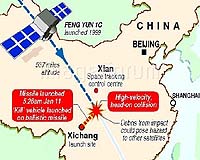
China startled the world Tuesday when it announced its first successful anti-satellite weapons test in space. The Chinese government said it had successfully destroyed one of its own weather satellites with a ballistic missile. The announcement sparked angry protests from the United States and Japan. However, Chinese Foreign Ministry spokesman Liu Jianchao responding by claiming that his country had displayed a "responsible attitude" and that it had "upheld the peaceful use of outer space," the Russian newspaper Pravda reported |
|
|

| The content herein, unless otherwise known to be public domain, are Copyright 1995-2006 - SpaceDaily.AFP and UPI Wire Stories are copyright Agence France-Presse and United Press International. ESA PortalReports are copyright European Space Agency. All NASA sourced material is public domain. Additionalcopyrights may apply in whole or part to other bona fide parties. Advertising does not imply endorsement,agreement or approval of any opinions, statements or information provided by SpaceDaily on any Web page published or hosted by SpaceDaily. Privacy Statement |