|
 |
 |
 |
 |
 |
 |
 |
 |

 |
China Plans To Have Over 100 Eyes In The Sky By 2020
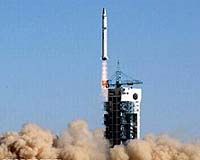
Beijing (XNA) Nov 17, 2004 China plans to launch more than 100 observation satellites before 2020. The Ministry of Science and Technology says a large surveillance network will be set up to monitor water reserves, forests, farmland, urban development and various events. The project's main goal is to make it possible to obtain data on any event at any time from space. China regularly sends research satellites into orbit and in October last year it became the third nation to successfully put a man in space. Last month, the retrievable chamber of China's 20th recoverable satellite returned to Earth with a bang, crashing through the roof of a house. And in August, China launched a satellite that carried out land and mapping surveys for several days before returning to Earth. China says it will also establish a long-term three dimensional satellite observation system to probe the world's land, air, and oceans, China Radio International reported on Tuesday. Sun Yanlai, director of China's National Space Administration made the comment at the 18th Plenary Meeting of Earth Observation Satellites Committee. He added that China would produce a new generation of meteorological, resources and ocean observation satellites by 2010. He revealed that China will also set up a small constellation for environmental and resource supervision and control. The constellation will consist of eight small satellites. The first three will be finished by 2007, while the rest five will be completed by 2010. The three-day Plenary Meeting of the Earth Observation Satellites Committee will focus on the latest developments in observation satellites. Community Email This Article Comment On This Article Related Links SpaceDaily Search SpaceDaily Subscribe To SpaceDaily Express The Chinese Space Program - News, Policy and Technology China News from SinoDaily.com
 Taikonauts On Moon A Far Off Dream For China Yet
 Beijing (XNA) Jan 05, 2006
A one-year lunar fly-by mission may start in April 2007 in China, but a manned flight to the Earth's neighbour may be a long way away, a chief lunar exploration scientist said last night. |
|
|

| The content herein, unless otherwise known to be public domain, are Copyright 1995-2006 - SpaceDaily.AFP and UPI Wire Stories are copyright Agence France-Presse and United Press International. ESA PortalReports are copyright European Space Agency. All NASA sourced material is public domain. Additionalcopyrights may apply in whole or part to other bona fide parties. Advertising does not imply endorsement,agreement or approval of any opinions, statements or information provided by SpaceDaily on any Web page published or hosted by SpaceDaily. Privacy Statement |