|
 |
 |
 |
 |
 |
 |
 |
 |

 |
China Opens New Chapter In Space History With Second Manned Mission
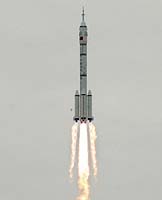
Jiuquan, China (AFP) Oct 12, 2005 China launched its second manned space mission Wednesday, sending two astronauts into orbit as it opened a new chapter in its ambitious drive to become a global space power. Shenzhou VI, based on Soviet Soyuz technology, lifted off on a Long March 2F carrier rocket from Jiuquan Satellite Launch Center at 9:00 am (0100 GMT) for a five-day mission, carrying air force pilots Fei Junlong and Nie Haisheng. It entered a fixed orbit 21 minutes later. Having two crew on board is a departure from October 2003, when Yang Liwei spent 21 hours on a solo odyssey -- a mission that made China only the third country after the United States and the former Soviet Union to send a man into space. "I feel good," said Fei in his first transmission from the craft. He later spoke with his son Fei Di and wife Wang Jie, who told him, "We are all pleased to see both of you are in good spirits ... we all feel very proud of you. All the family members are fine", according to the Xinhua news agency. Nei's wife Nie Jielin wished him good luck, Xinhua said. Fei, 40, and Nie, 41, were seen off at the launch pad in northwest China's Gansu province by Premier Wen Jiabao, who said he believed "the astronauts will accomplish the glorious and sacred mission". "The entire nation has waited, the entire world is watching the success of the Shenzhou VI manned space launch," he said, adding the "great achievement" would go down "in the annals of the history of the Chinese people." Amid some concern China could use space for military purposes, Wen said China's entry into conducting scientific experiments in space was "entirely for peaceful purposes" and to promote science. TV images showed the two astronauts comfortably flipping and reading flight books after going into space. This indicated they felt at ease and more comfortable than first Chinese astronaut Yang, who felt a strong tremor about two minutes after liftoff, Xinhua said. Millions of Chinese are estimated to have been glued to their TV sets watching the historic moment. The astronauts left the re-entry capsule and entered the orbital capsule -- a first for China -- about nine hours after blastoff. Yang, China's first astronaut, was strapped down in the return capsule throughout his mission. "This is a significant breakthrough of China's space technology," Wang Yongzhi, chief general designer of China's Manned Spaceflight Program, told Xinhua. Fei and Nie are expected to conduct experiments and scientific research in the orbital capsule. "They'll do quite a lot of medical tests, they'll take blood tests, urine tests, and they will also work out what kind of space food works for them," said Brian Harvey, the Dublin-based author of a book on China's space ambitions. "Because ultimately what they are planning is a space station ... and to do that they will need to learn how to survive on longer missions." The fact that Wednesday's mission carried two astronauts reflects the twin purposes of China's space program, which aims for both scientific gains and kudos at home and abroad. "If you are two people, you can do more complicated and more sophisticated types of work and experimentation," said Joan Johnson-Freese, an expert on China's space program at the US Naval War College. "Part of it is also prestige. Two people is harder than one person." Shenzhou VI is expected to circle the Earth in a pre-set orbit for the next 119 hours, or nearly five days, before landing in the Inner Mongolian grasslands in north China. The craft is based on the robust and thoroughly tested Soviet design for the Soyuz vessel, and consists of three modules. These include the orbital module where scientific experiments are carried out; the re-entry capsule where the astronauts will spend most of their time; and the service module, which contains fuel and air, solar panels and other technical gear. "This is the first time for Shenzhou spacecraft to apply the whole system, and the successful flight this time would indicate that China's technology in Shenzhou spacecraft is close to be mature," Zhang Bainan, chief designer of the spacecraft system, told Xinhua. Spending on the Shenzhou series of launches has reached roughly 19 billion yuan (2.3 billion US dollars), less than 10 percent of the US annual spending on space programs, Xinhua quoted a space science researcher with the Chinese Academy of Sciences saying. In Jiuquan city, several hours' drive from the satellite launch center, a sense of local pride was clearly visible, with large posters wishing for a successful launch seen outside hotels. "We're very happy about all this," said Ma Li, a teenage resident of Jiuquan city. "It's amazing that we Chinese gradually have the know-how to pull this kind of thing off." CAPTION AND BOX Outer Space Fish Balls Real Chinese Take-Away Beijing (AFP) Oct 12, 2005 Talk about a Chinese take-away. Astronauts Fei Junlong and Nie Haisjeng blasted into outer space on Wednesday with a full larder of Chinese specialities including cuttlefish and meat balls, and beef with orange peel, the state Xinhua news agency said. But the pair of orbiting diners will have to do without chopsticks, which were considered too difficult to manoeuvre in the weightlessness of space. They'll use forks and spoons instead. The menu for China's second manned space flight is much more extensive than that of the first manned mission in October 2003, offering 50 varieties of food instead of the previous 20, Xinhua said. Two years ago, the first Chinese astronaut Yang Liwei declared that his space food, such as chicken cooked with dates, was "great." But he ate only cold meals because the last spacecraft did not have a food heater. Fei and Nie will dine on heated food including rice, dehydrated vegetables and a wide assortment of fruit -- strawberries, bananas and the very sweet Chinese "Hami" melon. Community Email This Article Comment On This Article Related Links SpaceDaily Search SpaceDaily Subscribe To SpaceDaily Express The Chinese Space Program - News, Policy and Technology China News from SinoDaily.com
 Taikonauts On Moon A Far Off Dream For China Yet
 Beijing (XNA) Jan 05, 2006
A one-year lunar fly-by mission may start in April 2007 in China, but a manned flight to the Earth's neighbour may be a long way away, a chief lunar exploration scientist said last night. |
|
|

| The content herein, unless otherwise known to be public domain, are Copyright 1995-2006 - SpaceDaily.AFP and UPI Wire Stories are copyright Agence France-Presse and United Press International. ESA PortalReports are copyright European Space Agency. All NASA sourced material is public domain. Additionalcopyrights may apply in whole or part to other bona fide parties. Advertising does not imply endorsement,agreement or approval of any opinions, statements or information provided by SpaceDaily on any Web page published or hosted by SpaceDaily. Privacy Statement |