|
 |
 |
 |
 |
 |
 |
 |
 |

 |
China's Lunar Probe Chief Commander: Scientific Exploration, Not Competition
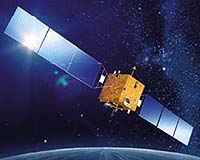
Xichang, China (XNA) Oct 25, 2007 China will not embark on any lunar probe competition "in any form with any country" and will "share the results of its moon exploration with the whole world" in its pursuit of a policy of peaceful use of airspace, said a chief commander of the country's first lunar satellite project. "The decision on the lunar probe was made completely in accordance with China's own conditions, which is not meant to be compared with others," Luan Enjie, chief commander of the lunar satellite project, told Xinhua, acknowledging that a new wave of moon exploration has started in recent years and many capable countries have mapped out their own moon probe plans. The lunar satellite, named Chang'e-1, was launched at 6:05 p.m on Wednesday from the Xichang Satellite Launch Center in southwestern Sichuan Province, marking the first step of China's ambitious three-stage moon mission and a new milestone in the country's space exploration history. "Chang'e-1 only conducts scientific missions, without any military aims and carrying no military facilities and equipment," said a spokesman of the Commission of Science, Technology and Industry for National Defense (COSTIND) on Wednesday. "When China has accumulated enough in space technology and economic strength, it's natural to make the decision to stride towards deep space exploration," said Luan, adding the moon probe was "the first step", which was in line with the basic principle of "scientific probing from the near to the far". Chinese scientists started systematic and comprehensive analysis and research about lunar science as early as mid-1960s, and started feasibility study on lunar probe plans in 1990s. A government White Paper on China's space technology released in 2000 disclosed Chinese ambitions in moon exploration for the first time. When China conducted lunar probe research and feasibility study, there were few moon probe activities in the world and most countries had not announced any new lunar exploration plans. "Our decision-making process was carried out without any exterior influences," Luan said. Chinese space experts, technicians and other work staff, joined by experts from Japan, Germany and other countries were watching the launching process on the spot Wednesday. More than a month ago, Chinese space experts were also invited to the launch site of a Japanese lunar satellite. "China welcomes international cooperation in space activities, "said Vice Minister of Science and Technology Li Xueyong, adding China hopes to become the 17th nation to join the International Space Station (ISS) project. The International Space Station is a joint project of 16 nations including the United States, Russia, Japan, Canada, Brazil and 11 countries from the European Space Agency. "China sincerely wants to cooperate with the United States in space exploration and join the International Space Station project that has already involved 16 nations," said Li. Although the United States and Soviet Union have made achievements in lunar probe, mankind still knew little about the moon and many fields remain to be explored, Luan said, citing "four scientific objectives" to be fulfilled by the China'e-1 satellite. "Scientists of different countries engaging in moon probe all set up their own scientific goals based on the field they are interested in," said Ouyang Ziyuan, chief scientist of the lunar probe project, who has been engaged in lunar science research for more than 30 years. "There are no good or bad goals. The achievements will upgrade the knowledge of the whole mankind towards the moon, not that of a certain country," Ouyang said. Chinese scientists and engineers "independently" completed research and production of the country's lunar probe project which boasted distinctive Chinese characteristics, said Luan, adding China's lunar probe "enriched mankind's moon probe activities and promoted development of deep space exploration worldwide". "It's a breakthrough for China and an important scientific exploration for the world," said the COSTIND spokesman.
Source: Xinhua News Agency Community Email This Article Comment On This Article Related Links The Chinese Space Program - News, Policy and Technology China News from SinoDaily.com
 Chang'e-1 - New Mission To Moon Lifts Off
 Paris, France (ESA) Oct 25, 2007
A bold new mission to the Moon was launched today by the Chinese National Space Administration (CNSA). Chang'e-1 blasted off from the Xichang Satellite Launch Centre, Sichuan, atop a Long March 3A rocket. Chang'e-1 represents the first step in the Chinese ambition to land robotic explorers on the Moon before 2020. Chang'e-1 has four mission goals to accomplish. The first is to make three-dimensional images of many lunar landforms and outline maps of major lunar geological structures. This mapping will include the first detailed images taken of some regions near the lunar poles. |
|
|

| The content herein, unless otherwise known to be public domain, are Copyright 1995-2007 - SpaceDaily.AFP and UPI Wire Stories are copyright Agence France-Presse and United Press International. ESA Portal Reports are copyright European Space Agency. All NASA sourced material is public domain. Additional copyrights may apply in whole or part to other bona fide parties. Advertising does not imply endorsement,agreement or approval of any opinions, statements or information provided by SpaceDaily on any Web page published or hosted by SpaceDaily. Privacy Statement |