|
 |
 |
 |
 |
 |
 |
 |
 |

 |
China Launches AsiaSat-6
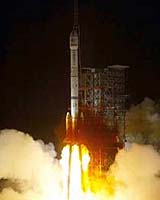
Xichang (XNA) Apr 13, 2005 China launched the APSTAR VI at the Xichang Satellite Launching Center in the south western province of Sichuan on Tuesday. It was the country's first commercial launching of a telecommunications satellite since 1999. At 20:00, a Long March 3-II rocket carrier sent the APSTAR VI into the skies. Twenty-five minutes later the rocket and the satellite separated as planned. The Long March 3-II is the most powerful of the Long March rocket family, being able to bring a maximum load of 5.1 tons into orbit, and therby meeting the different demands of commercial launchings in the world market. It was the 84th launch of the Long March series and the 42nd successful operation of Long March rockets since October 1996. The APSTAR VI is manufactured by the French company Alcatel for the owner and operator the APT Satellite Company, Hong Kong. The China Great Wall Industry Company is the general contractor of the project. The company will also launch the APSTAR VI B with a Long March 3-II, according to sources with the Great Wall. The APSTAR VI is 4.6 tons in weight and has 38 C channel transmitters and Ku channel transmitters. China has contracted more than 20 commercial launches of overseas satellites for a dozen foreign countries and regions. The APSTAR VI is the 30th overseas satellite launched by Chinese rocket carriers. According to the Xi'an Satellite Measuring and Controlling Center, the satellite entered synchronic orbit at a perigee of 209 kilometers, an apogee of 49,991 kilometers, and an orbital obliquity of 26 degrees.
China To Launch Another Satellite For Hong Kong Firm The APSTAR VI's launch was the first commercial launch atop a Chinese-made rocket in seven years. A spokesman for the company did not specify when APSTAR VI B of APT Satellite Limited will be launched. He said the same type of rocket would be used to launch the satellite from Xichang Satellite Launch Center, in China's southwest Sichuan Province. The spokesman said APSTAR VI B will be different from APSTAR VI, which had a platform and payload manufactured by French satellite manufacturer Alcatel. With the Chinese-made satellite platform Dongfanghong IV, APSTAR VI B will have only the payload manufactured by Alcatel. The satellite platform, developed by the Chinese Academy of Space Technology, is a new generation type of universal platform for the international communications market, said the spokesman. Satellites with the platform will have powerful transmitting capacities and long life spans, the spokesman said. China put the APSTAR VI into space Tuesday night atop the Chinese-made Long March 3B rocket from the launching center in Xichang to replace AsiaSat-1A. A spokesman for China Academy of Launch Vehicle Technology, said the flight is the 84th successful flight of China's Long-March launch vehicle since its maiden voyage in 1970, and the 42nd consecutive successful flight since October of 1996. The successful launch has proved that the Long March rocket, which has the largest carrying capacity of China's rockets, can project a satellite weighing 5,100 kg into orbit. The expert said the 62 successful flights of the rockets developed by the China Academy of Launch Vehicle Technology helped put 39 Chinese satellites, 28 overseas satellites and five space vessels, including a manned one, into orbit during the past 35 years. China first announced its decision to enter the international commercial launch market in 1985, successfully launching a US-made-satellite AsiaSat-1 in 1990. Source: Xinhua News Agency Community Email This Article Comment On This Article Related Links SpaceDaily Search SpaceDaily Subscribe To SpaceDaily Express The Chinese Space Program - News, Policy and Technology China News from SinoDaily.com
 Taikonauts On Moon A Far Off Dream For China Yet
 Beijing (XNA) Jan 05, 2006
A one-year lunar fly-by mission may start in April 2007 in China, but a manned flight to the Earth's neighbour may be a long way away, a chief lunar exploration scientist said last night. |
|
|

| The content herein, unless otherwise known to be public domain, are Copyright 1995-2006 - SpaceDaily.AFP and UPI Wire Stories are copyright Agence France-Presse and United Press International. ESA PortalReports are copyright European Space Agency. All NASA sourced material is public domain. Additionalcopyrights may apply in whole or part to other bona fide parties. Advertising does not imply endorsement,agreement or approval of any opinions, statements or information provided by SpaceDaily on any Web page published or hosted by SpaceDaily. Privacy Statement |