|
 |
 |
 |
 |
 |
 |
 |
 |

 |
China Lacks Incentive, Not Money, To Fix Environmental Problems
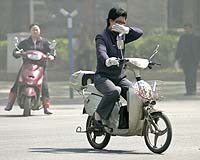
Beijing (AFP) Jul 03, 2005 Rapid economic growth has made China one of the world's worst polluters, but experts said the country's pollution problems are not due to an inability to clean up but to lack of incentives. Chinese officials and companies often cite China's status as a developing country and the high costs of switching to environmentally friendly methods of development for not effectively reducing pollution. Analysts, however, increasingly say China can afford to clean up. "Culturally, socially, I think there's still a widely held belief that they're not rich enough to clean up yet," said Dan Millison, environment and energy specialist for the Asian Development Bank (ADB). "The issue isn't whether it's affordable." The amount of money China needs to effectively reduce pollution is less than the amount it is losing to pollution, Millison said. China needs to invest about 2 percent of its annual GDP into pollution control to be effective, but is currently investing only about 1.3 percent, according to official statistics. At the same time, it is losing 9 to 10 percent of annual GDP in economic losses attributable to pollution, according to an ADB study. China is already the second worst country in the world in terms of emissions of greenhouse gases and is expected to surpass the United States as the biggest within 10 years. Despite the increasing problems, China's spending on environmental protection will fall 30 percent short of targets for 2001-2005, state media reported in March. The biggest source of air pollution in China are coal-fired power plants, which supply about 70 percent of its energy, but China is unlikely to rely less on coal in years to come despite wanting to diversify into cleaner power. The example of the power plants show that China's environmental problems often result from poor management, experts said, as the country doesn't lack technology or equipment to control pollution, but incentive. Companies prefer to build coal-fired power plants because they are cheaper than hydroelectric plants, but government policies also discourage change. Tariffs on power plants are based on the cost of building the plant. Since hydroelectric plants cost more, few companies build them. The pollution levies are also too low to be effective, say experts. "It's cheaper to pay the levy than to clean up the pollution," Millison said. Installing domestic emission control equipment in the plants would add only 5 percent to companies' operation cost and would eliminate at least two thirds of the sulphur dioxide emitted, but installation cost is not factored into the tariffs - leaving companies no incentive to control pollution. One of the easiest ways to control pollution would be to control wasteful energy consumption in China, but few effective measures have been taken to discourage waste, partly due to fears it could slow economic growth. Electricity charges remain low, even in richer eastern provinces. Factories are a key source of pollution, but instead of enforcing pollution control regulations on them, local government officials prefer to turn a blind eye to violations, for fear companies would move and take away needed jobs, said experts. "At the moment, if local officials want to keep their job or be promoted, it comes to how much GDP they can create," said Sze Pang Cheung, acting campaign director for Greenpeace China. "So they often carry out economic development at the expense of environmental protection." To spur economic growth, Chinese cities are also encouraging people to buy cars instead of spending more money on building subways, depite the fact that the explosion in the number of cars is greatly adding to air pollution. Some cities such as Beijing have banned highly polluting vehicles from their roads, but those vehicles are then simply sold to provinces with weaker guidelines. Chinese officials in charge of cleaning up the environment indicate the situation will get worse before it gets better. "China is still a developing country," Wang Jirong, deputy director of the State Environmental Protection Administration (SEPA), said recently. "Our development cannot stop." SEPA is, meanwhile, trying to convince the government to include environmental protection in the evaluation of local officials' performance. "The government recognizes they must do something," said Sze. "On the other hand, they don't want to sacrifice economic development." Community Email This Article Comment On This Article Related Links SpaceDaily Search SpaceDaily Subscribe To SpaceDaily Express China News from SinoDaily.com
 China Wants To Expand Sino-US Military Relations
 Beijing (AFP) Jan 10, 2006
China is ready to expand its military relations with the United States, Chinese Defense Minister Cao Gangchuan said on Tuesday. |
|
|

| The content herein, unless otherwise known to be public domain, are Copyright 1995-2006 - SpaceDaily.AFP and UPI Wire Stories are copyright Agence France-Presse and United Press International. ESA PortalReports are copyright European Space Agency. All NASA sourced material is public domain. Additionalcopyrights may apply in whole or part to other bona fide parties. Advertising does not imply endorsement,agreement or approval of any opinions, statements or information provided by SpaceDaily on any Web page published or hosted by SpaceDaily. Privacy Statement |