|
 |
 |
 |
 |
 |
 |
 |
 |

 |
China In Space: The Possibilities And Risks
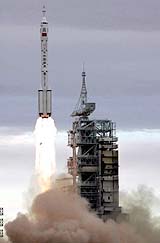
Washington DC (SPX) Nov 28, 2005 Last month, China opened a new chapter in the history of space exploration with its second manned orbital mission. But questions abound about the viability of the Chinese space program, its long-term goals and its implications for the United States and the West. For China the success of the Shenzhou 6 mission is a matter of prestige and national pride. For some analysts in the United States, Beijing's ambitious and secretive space program is cause for concern. Richard Fisher, Vice President of the International Assessment Strategy Center, a research group near Washington, D.C., says China's latest mission, which allowed two astronauts to conduct scientific experiments in low earth orbit, is driven by a number of economic and political goals. "The most important purpose for China is political inasmuch as the success of the manned space program allows the Communist Party-led government in Beijing to prove to the Chinese people that it can produce a major technological success that can lift the glory of China and give them a reason to be proud of the achievements of the Communist Party," says Mr. Fisher. While the manned missions also have some scientific value, other analysts say China ultimately wants to be a major player in space exploration. Charles Vick, a senior fellow at GlobalSecurity.org says China's space effort is a deliberate step-by-step program aimed at proving the country's capabilities in space. "They, of course, have the benefit of all the lessons and all the papers available on what has been done by previous countries in order to avoid problems. And that is the procedure they clearly are using. It would seem their program is certainly going in many very important directions that indicate China is very much seeking to be a world power in space." Like the United States, China is planning a manned lunar mission by 2020 to collect mineral samples and the isotope Helium 3, a potential energy source for future missions to the moon. In addition, Gregory Kulacki of the Massachusetts-based Union of Concerned Scientists says China has been focused on the economic importance of space since it began its manned program in 1992. He adds, "The piloted program is a flagship of a much larger aerospace engineering effort. It attracts foreign confidence in Chinese high technology the more they succeed with these missions. And it attracts -- and this is very important -- a large, energetic cadre of young Chinese engineers into the aerospace engineering community in China. Both of these things are strategic objectives of this program."
Space-Based Military Threats? While most observers agree that China's manned space program currently does not pose a military threat to the United States, many analysts, including Gregory Kulacki, say China's emerging satellite technology is cause for concern, especially if Beijing decides to sell it on the international market. He goes on to say, "Micro-satellites probably pose the most problematic technological development that the Chinese are pursuing in terms of our security in space. The Chinese are going to make space easier to access for a lot of people around the world. They're going to sell this technology to developing countries. This is going to create security problems for the United States and other countries. Of particular concern, most analysts say, is the degree to which the Chinese Army controls the country's space program. And according to U.S. Defense Department reports, Beijing is developing anti-satellite capabilities. The fact that the Chinese military controls both the manned space program and a large portion of the robotics program concerns John Logsdon, Director of the Space Policy Institute at The George Washington University. "They clearly are developing capabilities that would support their forces nd pose potential threats to adversary forces like the United States. And that's something to worry about," says Professor Logsdon. Some analysts agree. Richard Fisher of the International Assessment Strategy Center says China wants to expand its military options to better exploit space for military purposes. "All of the Shenzhou missions to date, all six in my opinion, have served military missions. The four unmanned missions were all equipped with either electronic intelligence or image intelligence-gathering devices. It is very likely that the sixth Shenzhou mission, the most recent, at least had some image intelligence-gathering devices. And the first manned space mission in 2003 had at least two imaging systems."
China Behind the Pack But some analysts say China's space effort has been so slow and sporadic that it does not pose a short-term military or reconnaissance threat. They point out, for example, that while Beijing routinely launches satellites, it does not maintain a permanent presence in space. Nonetheless, Charles Vick of GlobalSecurity.org warns that the direction the Chinese are taking with regard to their military modernization efforts, their long-range plans for a space station and lunar missions indicate that Beijing has the potential to pose a threat to western interests. He says, "Definitely by 2020, there could be a real threat that we would have to deal with. But by then we may be much more superior in our own military capabilities, moving forward as we have been." Most analysts agree that, in the meantime, Beijing's leadership needs to be more open about its space program and its goals to ease western suspicions. Many observers argue that more dialogue would help ensure that Beijing's space technologies don't find their way into the hands of rogue states or terrorists. Community Email This Article Comment On This Article Related Links SpaceDaily Search SpaceDaily Subscribe To SpaceDaily Express The Chinese Space Program - News, Policy and Technology China News from SinoDaily.com
 Taikonauts On Moon A Far Off Dream For China Yet
 Beijing (XNA) Jan 05, 2006
A one-year lunar fly-by mission may start in April 2007 in China, but a manned flight to the Earth's neighbour may be a long way away, a chief lunar exploration scientist said last night. |
|
|

| The content herein, unless otherwise known to be public domain, are Copyright 1995-2006 - SpaceDaily.AFP and UPI Wire Stories are copyright Agence France-Presse and United Press International. ESA PortalReports are copyright European Space Agency. All NASA sourced material is public domain. Additionalcopyrights may apply in whole or part to other bona fide parties. Advertising does not imply endorsement,agreement or approval of any opinions, statements or information provided by SpaceDaily on any Web page published or hosted by SpaceDaily. Privacy Statement |