|
 |
 |
 |
 |
 |
 |
 |
 |

 |
China Hopes Manned Spaceflight Will Open Road To Moon
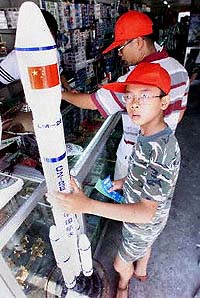
Beijing - May 21, 2002 On the opening day of a weeklong National Science and Technology Week on Saturday (May 18), Chinese space officials reiterated the goals of the first manned spaceflight with the Shenzhou-5 (SZ-5) mission and lunar exploration by 2010. The officials made the remarks in various public lectures, which the Chinese media widely reported. In a series of talks on the topic "Exploring space: Chinese lunar exploration is not a dream", space officials expressed confidence that the first manned mission would be launched before 2005, and the first lunar exploration mission might be realized much sooner than the end of the decade. The aim of the annual Science and Technology Week is to showcase advancement of Chinese science and technology, promote public science education, and stimulate the interest of youths to take up a science career. The theme of this year's activity is "Future on Science", with the opening day designated as "Space Exploration Day". The event, which takes place at the China Millennium Monument here, also has an exhibition of space images and models. Among the display is a full-scale mockup of the Shenzhou spacecraft, eight of the experiment payload that returned with SZ-3 recently, a simulated Martian landscape with a model of a rover that local high school students built, and the first cloud image transmitted from the recently launched Fengyun-1D metsat. About 4,000 people attended the event on Saturday. Huang Chunping, Chief Commander of the Changzheng-2F (CZ-2F) launcher program at the Chinese Academy of Launch Vehicle Technology (CALT), said that a successful SZ-4 mission later this year would pave the way for China to launch its yuhangyuans ("astronauts") after that. This places the earliest opportunity for the historic first manned mission on SZ-5. CZ-2F is the human-rated and improved version of the CZ-2E launcher, and is designed specifically for the manned space project. Huang also told the Hong Kong-based pro-Beijing newspaper Ta Kung Pao that China would be capable of mounting a manned lunar mission within three to four years. "China has now solved most of the manned space technology problems, and has the capability within three to four years to step on the Moon. In ten to fifteen years [China will] match the world's top level of space technology," said Huang. Huang considered that development of Chinese space technology should follow four stages: manned spaceflight, rendezvous and docking, establishing an orbital platform, and deep space exploration to the Moon and other planets. Huang pointed out that the key to mount a mission to the Moon would be funding. He said: "China has a huge industrial base and a powerful team of talents. The key problem is on funding. "The first phase of the manned space project technology and the pre-second phase technology research such as on docking has a total funding of $19 billion renminbi [US$2.3 billion], which is a large difference to that of other spacefaring nations." Ouyang Ziyuan, the Chief Scientist of the lunar exploration plan and a member of the Chinese Academy of Sciences, was also hopeful. But Ouyang was less specific about the timeline and only said that he was "very optimistic" about completing the first lunar mission before 2010. "China's Moon exploration plan has gone through detailed feasibility analysis and evaluation. In principle China has completely possessed lunar exploration capability," said Ouyang. He said that the near-term objective would be carrying out the unmanned lunar exploration plan. When the manned space technology is perfected, China would move on to the manned phase of the lunar exploration program. According to Ouyang China would begin the lunar program with a robotic resource exploration satellite. The spacecraft would orbit the Moon to conduct a comprehensive global sensing of resources -- for example helium-3, iron, titanium and water/ice -- and mapping of the surface environment, geomorphology and geological structure. The long-range objective of lunar exploration is to "establish a lunar base, and exploit and utilize the rich resources on the Moon," explained Ouyang. He firmly believed that China could land on the Moon before 2010 and hoped that the country would complete two lunar missions before the end of the decade. As soon as the central government issues the order to start the program, his team of researchers would come up with a Moon landing timetable. Ouyang added, "Give me $1 billion renminbi [US$120 million], then I can start the first lunar exploration." Community Email This Article Comment On This Article Related Links SpaceDaily Search SpaceDaily Subscribe To SpaceDaily Express The Chinese Space Program - News, Policy and Technology China News from SinoDaily.com
 Taikonauts On Moon A Far Off Dream For China Yet
 Beijing (XNA) Jan 05, 2006
A one-year lunar fly-by mission may start in April 2007 in China, but a manned flight to the Earth's neighbour may be a long way away, a chief lunar exploration scientist said last night. |
|
|

| The content herein, unless otherwise known to be public domain, are Copyright 1995-2006 - SpaceDaily.AFP and UPI Wire Stories are copyright Agence France-Presse and United Press International. ESA PortalReports are copyright European Space Agency. All NASA sourced material is public domain. Additionalcopyrights may apply in whole or part to other bona fide parties. Advertising does not imply endorsement,agreement or approval of any opinions, statements or information provided by SpaceDaily on any Web page published or hosted by SpaceDaily. Privacy Statement |