|
 |
 |
 |
 |
 |
 |
 |
 |

 |
China Displays New Nuclear Reactor
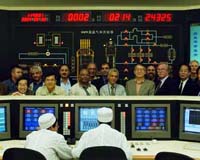
Beijing (XNA) (SPX) Oct 12, 2004 China showed off its first new generation of reactor on Beijing's northern outskirts Thursday, in an effort to demonstrate not only its safety and reliability, but its progress in overcoming its chronic energy shortage. The high-temperature gas-cooled reactor, designed at prestigious Tsinghua University in Beijing, was on display at a location near the Great Wall, roughly 40 km north of downtown Beijing. More than 60 atomic energy experts from over 30 countries watched the safety operation, in which the reactor successfully cooled down after the control stick was pulled out. The operation had been demonstrated before. Scientists have said the major safety issue regarding nuclear reactors lies in how to cool them efficiently, as they continue produce heat even after shutdown. Gas-cooled reactors are now widely considered the most secure. They don't need additional safety systems, as do water cooled reactor, and they discharge surplus heat, which could damage elements of the device. "It will not cause a catastrophe such as the one at Chernobyl in the Ukraine at any time," said Qian Jihui, former deputy chief of International Atomic Energy Agency (IAEA) and a noted atomic scientist with an international reputation. IAEA official Byung-Koo Kim said that the operation of the reactor was "rather impressive." Owing to technological improvement, Kim acknowledged, gas-cooled reactors will be introduced extensively for business purposes in the coming decades, and international cooperation will also be greatly reinforced. China is the fifth nation in the world to master the technology -- the others being the United States, Britain, Germany and Japan -- and remains in the lead in the peaceful application of nuclear energy, said Qian. Andrew C. Kadak, former president of the American Nuclear Society and a professor at Massachusetts Institute of Technology, said after the demonstration that MIT has reached an agreement with Tsinghua University on research cooperation. With an budget of more than 250 million yuan (approximately 30 million US dollars), the gas-cooled reactor was constructed in 1995 and incorporated into the power network in 2003. With helium refrigerant and ceramic components, fuel temperature in the reactor can reach up to 1,600 degrees Celsius. Qian said China is building another high-temperature gas-cooled reactor with a capacity of 160,000 kw. It will be completed in 2010 with a total cost of 2 billion yuan (some 240 million US dollars) at either Qingdao or Anqing City. China, which detonated its first atomic bomb in 1964, has focused on the civil use of nuclear energy since the 1980s. Two nuclear power plants started operation in the 1990s and four more are under construction. Their cost is much higher than ordinary power generators because they all use water-cooled reactors and imported technologies, noted Qian. Experts believe the use of gas-cooled reactors will significantly cut costs and enhance the competitive edge of nuclear power plants, which might finally trigger a new revolution in the energy field. Analysts held that China would surely run short of petroleum due to its rapid economic development and energy consumption. Nuclear electricity accounts for 2 percent of China's energy consumption. It is likely to reach 6 percent in 2020, still low compared with world average of 16 percent, the analysts said. Source: Xinhua News Agency Community Email This Article Comment On This Article Related Links SpaceDaily Search SpaceDaily Subscribe To SpaceDaily Express The Chinese Space Program - News, Policy and Technology China News from SinoDaily.com
 Taikonauts On Moon A Far Off Dream For China Yet
 Beijing (XNA) Jan 05, 2006
A one-year lunar fly-by mission may start in April 2007 in China, but a manned flight to the Earth's neighbour may be a long way away, a chief lunar exploration scientist said last night. |
|
|

| The content herein, unless otherwise known to be public domain, are Copyright 1995-2006 - SpaceDaily.AFP and UPI Wire Stories are copyright Agence France-Presse and United Press International. ESA PortalReports are copyright European Space Agency. All NASA sourced material is public domain. Additionalcopyrights may apply in whole or part to other bona fide parties. Advertising does not imply endorsement,agreement or approval of any opinions, statements or information provided by SpaceDaily on any Web page published or hosted by SpaceDaily. Privacy Statement |