|
 |
 |
 |
 |
 |
 |
 |
 |

 |
China Anti-Satellite Test Sparks Space Junk Outcry
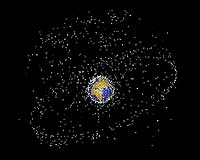
Paris (AFP) Jan 19, 2007 China's test of an anti-satellite weapon triggered charges Friday that it had caused dangerous debris to scatter into low Earth orbit, posing a potential threat to commercial, scientific and military satellites of other nations. "It looks really terrible. I am shocked," said a space scientist, explaining that the reported test took place in a region thickly populated by satellites, including those used for monitoring storms and climate change. "Space is not a playground for playing games," the scientist, outraged, said in an interview with AFP. "It's meant for the benefit of mankind." The website space.com, quoting sources that it did not identify, said the January 11 strike against the old Chinese weather satellite had caused it to smash up into "hundreds of hundreds of pieces, fluttering through low Earth orbit." "The mess of space junk does put other satellites, including the International Space Station, at some risk," space.com's Leonard David said, adding though that the chances of this were "very small." The main repercussion of Chinese test has been fears of an arms race in space -- but debris is another big source of concern. The space age reaches 50 years on October 4 this year -- the anniversary of the launch of the Soviet satellite Sputnik -- and there are hundreds of thousands of pieces whirling in orbit, the result mainly of exploded rocket stages and broken-up satellites. David Wright, co-director of the Global Security Programme at the Union of Concerned Scientists (UCS), a US private advocacy group, said the satellite that was destroyed had a mass of 750 kilos (1,650 pounds) and had been orbiting at an altitude of 850 kilometers (520 miles). Many commercial, military and navigational satellites orbit in the region of 900 kilometers (560 miles), he said. The maximum altitude of the International Space Station is around 450 kilometers (280 miles). "The collision would be expected to completely fragment the satellite into millions of pieces of debris -- nearly 800 debris fragments of size 10 centimeters (four inches) or larger, nearly 40,000 debris fragments with size between one and 10 centimeters (half to four inches) and some two million fragments of size one millimeter (0.04 inch) or larger," said Wright. "At the very high speeds these debris particles would have, particles as small as one millimeter (0.04 inch) can be very destructive." Most satellites do not carry sufficient shielding for even tiny particles like this, and in any case shielding is ineffective against any debris larger than about one centimetre (half an inch) in size," said Wright in a statement. The orbital region "is very heavily used by satellites for both civil and military uses, which are threatened by the added debris," he warned Among those who voiced fears was Australia, which said on Friday that, in addition to worries about the militarisation of space, "we're concerned about the impact that debris from destroyed satellites could have on other satellites, which are very expensive pieces of equipment." The danger from debris comes from the enormous speeds at which they travel, which means even very small pieces impact with high energy. In 1996, a French spy satellite, Cerise, was wacked at about 50,000 kilometers (30,000 miles) per hour by a wheeling fragment left from an exploded Ariane rocket. In June 1983, the windscreen of the US space shuttle Challenger had to be replaced after it was chipped by a fleck of paint measuring 0.3mm (0.01 of an inch), that impacted at four kms (2.5 miles) per second. The worst debris clouds are in two main areas -- in low Earth orbit (LEO), which is at an altitude of between 800 and 1,500 kilometers (500 and 950 miles) above the Earth, and in geostationary orbit, about 35,000 kms (22,000 miles) away. In LEO, debris can take a decade or longer before eventually burning up on contact with Earth's atmosphere. The Chinese test was first reported by US magazine Aviation Week and Space Technology and confirmed by the White House. The only other anti-satellite test that has been carried out was in September 1985 by the United States. Its method, as China's, was a "kinetic energy" weapon, essentially slamming a projectile into the target.
Source: Agence France-Presse Community Email This Article Comment On This Article Related Links Read More About the Chinese Space Program Taiwan News at SinoDaily.com Learn about the Superpowers of the 21st Century at SpaceWar.com Learn about laser weapon technology at SpaceWar.com Learn about missile defense at SpaceWar.com The Chinese Space Program - News, Policy and Technology China News from SinoDaily.com
 No Response From China On US Space Complaints Says White House
 Washington (AFP) Jan 19, 2007
China has yet to respond to US concerns about its space program, the White House said Friday, adding that Washington hopes for "cooperation on a civil space strategy" with Beijing. "We've expressed our concern to the Chinese, both to our Chinese officials here in (Washington), DC and in Beijing," said spokeswoman Dana Perino. |
|
|

| The content herein, unless otherwise known to be public domain, are Copyright 1995-2006 - SpaceDaily.AFP and UPI Wire Stories are copyright Agence France-Presse and United Press International. ESA PortalReports are copyright European Space Agency. All NASA sourced material is public domain. Additionalcopyrights may apply in whole or part to other bona fide parties. Advertising does not imply endorsement,agreement or approval of any opinions, statements or information provided by SpaceDaily on any Web page published or hosted by SpaceDaily. Privacy Statement |