|
 |
 |
 |
 |
 |
 |
 |
 |

 |
China Admits Chemical Blast Polluted Major River, City Without Water
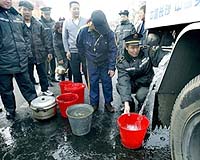
Harbin, China (AFP) Nov 23, 2005 A chemical plant explosion has severely polluted one of China's biggest rivers, the government said Wednesday, causing water supplies to be cut for millions of people and sparking pollution fears in neighbouring Russia. The explosion at a PetroChina factory in the northeastern province of Jilin led to an outpouring of the carcinogen benzene into the 1,897-kilometer-long (1,176-mile) Songhua river, the Environmental Protection Administration (EPA) said. "After the blast at the chemical plant the monitoring station in Jilin found that benzene went into the river and polluted the water," the EPA said in a statement on its website. "Benzene levels were 108 times above national safety levels." The announcement came 10 days after the November 13 explosion and followed repeated denials from government officials that there had been any major environmental impact. In Harbin, the capital of neighbouring Heilongjiang province about 380 kilometers downstream from the blast site, water supplies were cut off at midnight on Tuesday over the pollution fears, the local government said. The Songhua is the main source of drinking water for more than three million urban residents of Harbin, which has a total population of about nine million and is one of China's biggest cities. The EPA said the pollutants in the water were expected to hit Harbin around 5:00 am on Thursday, although the contaminants would be diluted. Xinhua news agency quoted government sources as saying that Harbin needs 1,400 tons of active carbon to purify the contaminated water in the Songhua but is currently 700 tons short. The polluting material index had dropped to 29 times above national safety levels when the contaminants reached the border of Jilin and Heilongjiang on Sunday, the EPA said. However the polluted water flowed past Songyuan and Zhaoyuan, two big cities between the blast site and Harbin that lie along the Songhua, before the government admitted the contamination. Songyuan has a population of just under three million and Zhaoyuan has about 450,000 residents. An official from Songyuan city government told AFP on Wednesday that its water supplies had not been cut over the past 10 days. Russian government officials in the east of their country also said Wednesday they were monitoring the Amur river, of which the Songhua is a tributary, for toxic substances. The officials said the Songhua (called Sungari in Russia) was the main source of drinking water for the Russian city of Khabarovsk, home to 600,000 residents, just across the Chinese border about 600 kilometres from Harbin. "Fairly large quantities of benzol (benzene), a potent carcinogen, have clearly been dumped into the water," said the head of the Russian far east office of conservation organisation WWF, Yuri Darman. "This water will reach Khabarovsk within three or four days." Benzene is a carcinogen that can be lethal if someone is exposed to high levels, even in small doses, according to the US National Library of Medicine's website. In Harbin there had been scenes of panic since the weekend when rumours first surfaced that water supplies would be cut off. With initial government denials over contaminated water being the reason for the stoppage, residents were left to speculate about a potential imminent earthquake as they hoarded water and food. "The government has said the water is going to be cut for four days but I don't know whether to believe them or not so we're stocking up," a woman surnamed Cai said Wednesday night as she walked out of the Walmart shop in Harbin with six big bottles of water in her arms. Locals were also beginning to dig wells, Xinhua news agency said, while the government continued to bring in bottled water from other regions. Schools in Harbin were closed for a week although hospitals remained open. The Harbin government did not say how long the water supplies would be cut, but a Xinhua report on Wednesday evening cited a local official as saying the poisoned stretch of water would flow out of the city on Saturday morning. The November 13 explosion at the PetroChina petrochemical plant killed at least five people and led to the temporary evacuation of thousands of residents amid fears of the emission of toxic gases. Community Email This Article Comment On This Article Related Links SpaceDaily Search SpaceDaily Subscribe To SpaceDaily Express Our Polluted World and Cleaning It Up
 Toxin Level In Chinese River Still Unsafe
 Beijing (AFP) Jan 11, 2006
Levels of a cancer-causing chemical found in a Chinese river are still above safety standards after a spill last week, despite earlier official reassurances, state media reported Wednesday. |
|
|

| The content herein, unless otherwise known to be public domain, are Copyright 1995-2006 - SpaceDaily.AFP and UPI Wire Stories are copyright Agence France-Presse and United Press International. ESA PortalReports are copyright European Space Agency. All NASA sourced material is public domain. Additionalcopyrights may apply in whole or part to other bona fide parties. Advertising does not imply endorsement,agreement or approval of any opinions, statements or information provided by SpaceDaily on any Web page published or hosted by SpaceDaily. Privacy Statement |