|
 |
 |
 |
 |
 |
 |
 |
 |

 |
Chimps Like Us Utilise Referential Gesturing
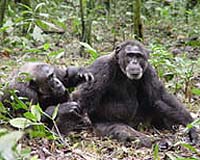
Ann Arbor MI (SPX) Mar 24, 2006 It was once thought that only humans gestured to direct another person's attention, but such "referential" gesturing was recently observed in wild chimpanzees. John Mitani, University of Michigan anthropology professor, and colleague Simone Pika, a postdoctoral fellow in psychology at University of St. Andrews in Scotland, observed male chimps habitually using "directed scratches" to request grooming of specific areas on the body. The findings suggest that our closest living relatives may be capable of mental-state attribution, making inferences about the knowledge of others. Up until now, scientists saw directed scratching only in captive chimps and language-trained apes who interacted with humans, Mitani said. "The more we learn, the more we see chimpanzees employing remarkable, seemingly human-like behaviors," Mitani said. "To me that is one of the lessons of this little paper." The findings appear in today's issue of Current Biology, in a paper entitled "Referential Gestural Communication in Wild Chimpanzees." To reach their conclusions, Pika and Mitani studied the social grooming habits of male chimps in the Ngogo community in Uganda's Kibale National Park. During observation, male chimps routinely scratched a certain spot on themselves in view of their grooming partner, usually in a loud, exaggerated manner. In the majority of cases (64 percent) the groomer responded immediately by stopping and moving to groom the exact spot the gesturer had just scratched, Mitani said. The behavior appeared frequently between males who formed strong social bonds, and Mitani surmised that further study might reveal that males who do not display such friendly relations do not engage in the behavior as often. "It's almost as if it's being used selectively by males who know that they are going to obtain a positive response," similar to asking a friend for a favor as opposed to a stranger, Mitani said. Pika and Mitani observed male chimps because they groom each other more frequently than females do. Historically, researchers thought animal gestures provide information only about the communicator's emotional state. Referential communication, such as pointing to something in the external environment with the expectation of a specific response from another, was considered beyond the capability of non-human primates in the wild. However, scientists have known for some time that animals use calls to refer to objects and events in the external world in a seemingly referential fashion, Mitani said. For example, an animal might utter distinct warning sounds to denote different kinds of predators. However, documenting the use of referential gestures in animals has lagged behind, Mitani said. Community Email This Article Comment On This Article Related Links University of Michigan University of St. Andrews All About Human Beings and How We Got To Be Here
 How Does The Brain Know What The Right Hand Is Doing
 Sydney, Australia (SPX) Mar 24, 2006
You don't have to watch your legs and feet when you walk. Your brain knows where they are. For decades scientists have debated two options for how the brain achieves this: |
|
|

| The content herein, unless otherwise known to be public domain, are Copyright 1995-2006 - SpaceDaily.AFP and UPI Wire Stories are copyright Agence France-Presse and United Press International. ESA PortalReports are copyright European Space Agency. All NASA sourced material is public domain. Additionalcopyrights may apply in whole or part to other bona fide parties. Advertising does not imply endorsement,agreement or approval of any opinions, statements or information provided by SpaceDaily on any Web page published or hosted by SpaceDaily. Privacy Statement |