|
 |
 |
 |
 |
 |
 |
 |
 |

 |
Chemical Imaging Offers Potential New Crime Busting Tool
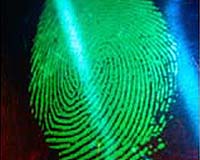
London UK (SPX) Aug 09, 2007 A new fingerprinting technique could potentially detect the diet, race and sex of a suspected criminal, according to new research published in the August edition of the journal Analytical Chemistry. The team, led by Professor Sergei Kazarian from Imperial College London's Department of Chemical Engineering, has devised a technique which collects fingerprints along with their chemical residue and keeps them intact for future reference. Chemical residues contain a few millionths of a gram of fluid and can be found on all fingerprints. Conventional fingerprinting techniques often distort or destroy vital chemical information with no easy way of lifting residues for chemical imaging, until now. Imperial scientists found that the use of gel tapes, commercial gelatine based tape, provides a simple method for collection and transportation of prints for chemical imaging analysis. The prints, once lifted, are analysed in a spectroscopic microscope. The sample is irradiated with infrared rays to identify individual molecules within the print to give a detailed chemical composition. The information is then processed by an infrared array detector, originally developed by the U.S. military in smart missile technology. The array detector chemically maps the residue. This process builds up a picture, or chemical photograph, and allows for the most comprehensive information obtained from a fingerprint. "The combined operational advantages and benefits for forensic scientists of tape lifting prints and spectroscopic imaging really maximises the amount of information one can obtain from fingerprints. Our trials show that this technique could play a significant role in the fight against crime," said Professor Kazarian. In many cases, this information is enough to determine valuable clues about a person beyond the fingerprint itself. It could potentially identify traces of items people came in contact with, such as gunpowder, narcotics and biological or chemical weapons. Chemical clues could also highlight specific traits in a person. A strong trace of urea, a chemical found in urine, could indicate a male. Weak traces of urea in a chemical sample could indicate a female. Specific amino acids could potentially indicate whether the suspect was a vegetarian or meat-eater. Professor Kazarian believes that this technique could allow forensic scientists to observe how fingerprints change in time and within different environments. "By focussing on what is left in a fingerprint after periods of time, scientists could potentially gauge how old a crime scene is. Studying what happens to prints, when they are exposed to high temperatures, could also be particularly significant, especially in arson cases where lifting prints has been notoriously hard," he said. Speculating about the possible future benefits of this process, Professor Sergei Kazarian said: "In the courtroom of the near future, chemical images could feature as key evidence. I hope our work assists law enforcement authorities to bring dangerous criminals to justice." Community Email This Article Comment On This Article Related Links Imperial College London Analytical Chemistry The latest in Military Technology for the 21st century at SpaceWar.com
 Tanks Still Rule
 Washington (UPI) Aug 08, 2007
Main battle tanks are not obsolete in war, so General Dynamics should keep making them. The U.S. Army went into Iraq with a line of battle still determined by the supposedly obsolete requirements of the Cold War. Former Defense Secretary Donald Rumsfeld spent his six years in office supposedly trying to shrink the Army down to a "lean, mean and agile" configuration to face the challenges of a complex new world. Given the way the Iraqi and Afghan conflicts have evolved, it's understandable that MBTs should be out of favor with U.S. policymakers and military theorists alike these days. |
|
|

| The content herein, unless otherwise known to be public domain, are Copyright 1995-2007 - SpaceDaily.AFP and UPI Wire Stories are copyright Agence France-Presse and United Press International. ESA Portal Reports are copyright European Space Agency. All NASA sourced material is public domain. Additional copyrights may apply in whole or part to other bona fide parties. Advertising does not imply endorsement,agreement or approval of any opinions, statements or information provided by SpaceDaily on any Web page published or hosted by SpaceDaily. Privacy Statement |