|
 |
 |
 |
 |
 |
 |
 |
 |

 |
Chasing Dust Devils
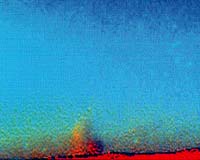
Moffet Field (SPX) Jun 07, 2004 Mars has only a faint atmosphere [less than one percent of terrestrial pressures], yet offers up its history of dust devils as swirling tracks in a remarkable landscape of wind-swept and carved terrain. These tiny twisters tend to appear in the middle afternoon on Mars, when solar heating is maximum and when warm air rises and collides with other pressure fronts to cause circulation. In his first press conference after the Spirit rover landed, the principal investigator for the rover's science package, Cornell's Steven Squyres, described one instance his team has been discussing: the intriguing possibility that at Gusev, over their three-month mission, the rover's camera may actually be able to animate a dust devil in action. Squyres informally proposed a mini-series of frames, or twister movie which with some meterological luck, might offer a rare example of surface weather on another planet.
Ares Vallis Dust Devil
Dust Events "These martian dust devils dwarf the five-to-10 meter terrestrial ones, can be greater than 500 meters in diameter and several thousand meters high. The track patterns are known to change from season to season, so these huge dust pipes must be a large factor in transporting dust and could be responsible for eroding landforms," said Peter Smith of the University of Arizona (Tucson) who led the 2002 MATADOR (Martian Atmosphere and Dust in the Optical and Radio) activity. "At the Pathfinder site during its 83 sol mission, approximately thirty dust devils were either sensed by the pressure drop as they passed over the lander, or were imaged by the Pathfinder camera," says Smith. "Based on these observations, one might expect to see several dust devils per hour from an active site on Mars between 10 am and 3 pm. Few, if any dust devils will be present at other times. Dust devils typically form during late spring and summer and can be found at all latitudes. Exactly, how their population density varies around the planet is currently unknown." In addition to Pathfinder's run-in with a dust devil, previous missions to Mars have run into very dusty days. For instance, there was a dust storm covering the Viking Lander I (VL-1) site on Martian day (1742) or sol 1742 (1 Martian year=669 Earth days). In 1971, Mariner 9 and 2 USSR missions all arrived during a dust storm. No dust devils have been imaged yet at the Spirit site, Gusev Crater, but mission scientists continue to look in the mid-afternoon for rising, circulating air that might be compared with a dusty pattern on the horizon. But actually chasing such a storm on Mars is something any rover will likely need to steer clear from. Martian dust includes magnetic, composite particles, with a mean size of one micron--the equivalent to powdered cement or fluor in consistency. This size range is about five percent the width of a human hair. "Rovers and other robots must be carefully designed to withstand the sandblasting that they will endure from dust devils," said Smith. "Bearing surfaces and solar panels must be protected and dust accumulation on solar panels will lower their efficiency." Squyres has had to prepare for a host of such dust related issues that may affect the timing of certain instruments on-board the rovers. He wrote in his mission diaries: "Our Microscopic Imager has to have a dust cover. After all, if you're going to be waving a sensitive scientific camera around on the surface of the dustiest planet in the solar system, it makes sense to have a cover to keep the lens clean. And the cover has to be transparent. We use a motor to open and close it, and the motor is a very reliable one. But even so, if it fails for some reason, we want to be sure we still can take pictures ...Lori Shiraishi and a couple of the other mechanical wizards at JPL looked real hard at the thing, and somehow managed to come up with a special tool that let them snake their way in there, get to the cover, and get it off the camera. If they weren't mechanical engineers, I think they'd be safe crackers". The color calibration of the Pancam is strongly affected by dust in the atmosphere, just as terrestrial dust scatters light here on Earth and casts a blue sky during the day. On Mars, the sky is pinkish-orange, depending on local conditions. The Pancam has its own color-calibration targets to adjust for changes in local dustiness, but as Bill Nye, project lead for analyzing solar shadows on Mars for his Marsdial project, "If it's dusty out, we won't do the sundial observation time-lapse that day. But, the photometric calibration targets are still useful on dusty days. They have color patches and reflective surfaces, and so on. If the shadow is washed out by diffused light, well, the useful effects of pink or orange shadows have to be inferred and approximated without observation. As far as I know, the pan-cams are to be run every day or sol. The useful time for the missions and the cameras is probably going to depend on how much dust settles on the solar panels. It's an odd or surprising constraint. But that's it, if nothing else goes wrong. We may be able to fire the space crafts back up during the next Martian summer. We'll see, perhaps literally." Planetary scientist, Bill Hartmann, is a member of the MGS team and also a talented painter and author. Before the mission, he spoke with Astrobiology Magazine about the interesting possiblities for interpreting not just the geology of the landing site, but also atmospheric phenomena like dust devils and weather. "On my easel I have a newly started painting of the light filtering through a Martian dust storm." Community Email This Article Comment On This Article Related Links Mars Rovers at JPL Mars Rovers at Cornell SpaceDaily Search SpaceDaily Subscribe To SpaceDaily Express Mars News and Information at MarsDaily.com Lunar Dreams and more
 Spirit Heading To 'Home Plate'
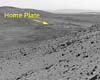 Pasadena CA (JPL) Jan 09, 2006
Last week Spirit completed robotic-arm work on "El Dorado." The rover used all three of its spectrometers plus the microscopic imager for readings over the New Year's weekend. |
|
|

| The content herein, unless otherwise known to be public domain, are Copyright 1995-2006 - SpaceDaily.AFP and UPI Wire Stories are copyright Agence France-Presse and United Press International. ESA PortalReports are copyright European Space Agency. All NASA sourced material is public domain. Additionalcopyrights may apply in whole or part to other bona fide parties. Advertising does not imply endorsement,agreement or approval of any opinions, statements or information provided by SpaceDaily on any Web page published or hosted by SpaceDaily. Privacy Statement |