|
 |
 |
 |
 |
 |
 |
 |
 |

 |
Charge Doping Of Molecules One Atom At A Time Using STM
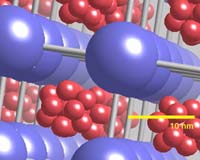
Philadelphia - Mar 04, 2004 While the semiconductor industry today routinely dopes bulk silicon with billions of atoms of boron or phosphorous to obtain desired electrical properties, a team of physicists at the University of California, Berkeley, has succeeded in changing the properties of a single molecule by doping it just one atom at a time. "We can precisely change the exact number of dopant atoms attached to a single molecule, either adding or removing them, which is something no one has been able to do before. We've really shown a new level of control of the electronic properties of a molecule," said Michael F. Crommie, UC Berkeley professor of physics and a faculty scientist at Lawrence Berkeley National Laboratory. This precise control and reversible tuning of individual molecules becomes ever more important as electronic devices shrink in size, to the point where individual molecules become the circuit elements. "The whole idea of controlling the nature of these little molecular structures is really going to help us understand exactly how they behave and how to control their behavior in an electronic device," Crommie said. Crommie and his colleagues - UC Berkeley graduate students Ryan Yamachika and Michael Grobis and post-doctoral fellow Andrei Wachowiak - report their success in the March 12 issue of Science. The physicists used a scanning tunneling microscope (STM) to move a buckyball - a cage-like molecule composed of 60 carbon atoms - around on a surface to pick up one potassium atom at a time, each one slightly altering the electrical properties of the buckyball. They've been able to add as many as seven to a single buckyball, which is the nickname for buckminsterfullerene, named after the creator of the geodesic dome, architect Buckminster Fuller. "We've shown you can take a single molecule and add atoms to it that donate charge to the molecule, thereby changing the molecular electronic properties in much the same way that silicon semiconductor properties are changed when you add dopant atoms to it," Crommie said. "We can add one atom to the molecule, or two atoms or three atoms, or we can remove them, so we can change properties in situ while we are looking at it to see how the molecules' properties behave." Theoretically, two molecules with different kinds of attached atoms could be placed next to one another to create a P-N junction - the simplest semiconductor circuit that acts as a basic diode. Crommie predicts the technique could be used to attach different kinds of dopant atoms to buckyballs and perhaps other types of molecules as well. "This is just one of many ideas that people are currently pursuing and will pursue more in the future, and this new work has a bearing on that," he said. "It's an important step in creating new functionality in a molecular structure." Crommie said that buckyballs can be thought of as a geodesic sphere of 60 positively charged carbon nuclei with a gas of electrons enveloping them. When a potassium atom gloms onto the buckyball, its electron joins the other electrons swimming around the carbon atoms, filling up the buckyball and altering the properties in a way analogous to the way phosphorus added to silicon alters the electrical properties of silicon. He and his colleagues were able to exercise such precise control of the buckyball thanks to their homemade, state-of-the-art STM, cooled to 7 degrees above absolute zero (7 Kelvin) in an ultrahigh vacuum and optimized for dragging molecules around a surface. The tip or probe of the STM was used to move the buckyballs over potassium atoms absorbed on a silver surface. The buckyballs immediately snatched up whichever potassium atoms they came into contact with as they were herded around the surface. The potassium atoms could be removed from the buckyballs by dragging them over special regions of the silver surface. At the moment, the doped buckyballs must remain on the surface - when the buckyballs are picked up, the potassium atoms detach and remain behind. The STM tip was then used as a probe to "photograph" the surface arrangement and determine the electronic properties of the altered buckyballs. Community Email This Article Comment On This Article Related Links University of California - Berkeley SpaceDaily Search SpaceDaily Subscribe To SpaceDaily Express Nano Technology News From SpaceMart.com Computer Chip Architecture, Technology and Manufacture
 Water, Water Everywhere Nano
 New York (UPI) Mar 18, 2005
One of the single biggest applications of nanotechnology could be solving the global shortage of pure water, experts told UPI's Nano World. |
|
|

| The content herein, unless otherwise known to be public domain, are Copyright 1995-2006 - SpaceDaily.AFP and UPI Wire Stories are copyright Agence France-Presse and United Press International. ESA PortalReports are copyright European Space Agency. All NASA sourced material is public domain. Additionalcopyrights may apply in whole or part to other bona fide parties. Advertising does not imply endorsement,agreement or approval of any opinions, statements or information provided by SpaceDaily on any Web page published or hosted by SpaceDaily. Privacy Statement |