|
 |
 |
 |
 |
 |
 |
 |
 |

 |
Chandra Peers At Cosmic Super Bubbles
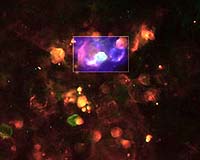
Boston MA (SPX) Sep 06, 2007 Using the Chandra X-ray Observatory, astronomers explored a particular region of clouds and gas where stars are forming in one of the Milky Way's closest galactic neighbors. Combining X-ray data (blue and purple) with other wavelengths, researchers found evidence for the formation of a so-called superbubble. Superbubbles are formed when smaller structures from individual stars and supernovas combine into one giant cavity. The Chandra data shows evidence for three supernova explosions in this relatively small region. The Chandra X-ray Observatory is part of NASA's ?eet of "Great Observatories" along with the Hubble Space Telescope, the Spitizer Space Telescope and the now deorbited Compton Gamma Ray Observatory. Chandra allows scientists from around the world to obtain unprecedented X-ray images of exotic environments to help understand the structure and evolution of the universe. Already surpassing its ?ve-year life, NASA's Chandra X-ray Observatory is rewriting textbooks and helping advance technology.
Chandra X-ray Center The Smithsonian Astrophysical Observatory (SAO) in Cambridge, Mass., is responsible for the conduct of the day-to-day ?ight operations and science activities from the Operations Control Center and Chandra X-ray Center (CXC) facilities. SAO also coordinates science planning for the observing program and provides user support as science products are made available to the scienti?c community. The CXC Web site is the primary resource for information on the Chanda X-ray Observatory mission, providing comprehensive materials such as news releases, photos, status reports, and mission background materials. Community Email This Article Comment On This Article Related Links Chandra X-ray Center Stellar Chemistry, The Universe And All Within It
 Stellar Firework In A Whirlwind
 Paris, France (SPX) Sep 05, 2007
Stars do not like to be alone. Indeed, most stars are members of a binary system, in which two stars circle around each other in an apparently never-ending cosmic ballet. But sometimes, things can go wrong. When the dancing stars are too close to each other, one of them can start devouring its partner. If the vampire star is a white dwarf - a burned-out star that was once like our Sun - this greed can lead to a cosmic catastrophe: the white dwarf explodes as a Type Ia supernova. |
|
|

| The content herein, unless otherwise known to be public domain, are Copyright 1995-2007 - SpaceDaily.AFP and UPI Wire Stories are copyright Agence France-Presse and United Press International. ESA Portal Reports are copyright European Space Agency. All NASA sourced material is public domain. Additional copyrights may apply in whole or part to other bona fide parties. Advertising does not imply endorsement,agreement or approval of any opinions, statements or information provided by SpaceDaily on any Web page published or hosted by SpaceDaily. Privacy Statement |