|
 |
 |
 |
 |
 |
 |
 |
 |

 |
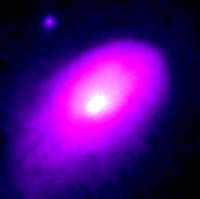
Chandra Maps Cosmic Pressure Front
Washington - March 1, 2000 - A colossal cosmic "weather system" produced by the collision of two giant clusters of galaxies has been imaged by NASA's Chandra X-ray Observatory. For the first time, the pressure fronts in the system can be traced in detail, and they show a bright but relatively cool 50 million degree central region embedded in a large elongated cloud of 70 million degree gas, all of which is roiling in a faint "atmosphere" of 100 million degree gas. "We can compare this to an intergalactic cold front," said Maxim Markevitch of the Harvard-Smithsonian Center for Astrophysics, Cambridge, Mass., and leader of the international team involved in the analysis of the observations. "A major difference is that in this case, cold means 70 million degrees." The gas clouds are in the core of a galaxy cluster known as Abell 2142. The cluster is six million light years across and contains hundreds of galaxies and enough gas to make a thousand more. It is one of the most massive objects in the universe. Galaxy clusters grow to vast sizes as smaller clusters are pulled inward under the influence of gravity. They collide and merge over the course of billions of years, releasing tremendous amounts of energy that heats the cluster gas to 100 million degrees. The Chandra data provides the first detailed look at the late stages of this merger process. Previously, scientists had used the German-US Roentgen satellite to produce a broad brush picture of the cluster. The elongated shape of the bright cloud suggested that two clouds were in the process of coalescing into one, but the details remained unclear. Chandra is able to measure variations of temperature, density and pressure with unprecedented resolution. "Now we can begin to understand the physics of these mergers, which are among the most energetic events in the universe," said Markevitch. "The pressure and density maps of the cluster show a sharp boundary that can only exist in the moving environment of a merger." With this information scientists can make a comparison with computer simulations of cosmic mergers. This comparison, which is in the early stages, shows that this merger has progressed to an advanced stage. Strong shock waves predicted by the theory for the initial collision of clusters are not observed. It appears likely that these sub-clusters have collided two or three times in a billion years or more, and have nearly completed their merger. The observations were made on August 20, 1999 using the Advanced CCD Imaging Spectrometer (ACIS). The team involved scientists from Harvard-Smithsonian; the Massachusetts Institute of Technology, Cambridge, Mass.; NASA's Marshall Space Flight Center, Huntsville, Ala.; the University of Hawaii, Honolulu; the University of Birmingham, U.K.; the University of Wollongong, Australia; the Space Research Organization Netherlands; the University of Rome, Italy; and the Russian Academy of Sciences. The results will be published in an upcoming issue of the Astrophysical Journal.
Email This Article Comment On This Article Related Links Space
 Satellite Launch To Boost DTH In India
 Calcutta, India (SPX) Dec 28, 2005
The successful launch Thursday of India's heaviest satellite from spaceport of Kourou in French Guyana may have boosted the country's space research efforts to yet another level, but it has also lifted the spirits of at least three Direct-To-Home televisions broadcasters, one of which has been waiting for years to launch its services in India. |
|
|

|
|
|
|
|
|
|
|
|
|
|
|
| The content herein, unless otherwise known to be public domain, are Copyright 1995-2006 - SpaceDaily.AFP and UPI Wire Stories are copyright Agence France-Presse and United Press International. ESA PortalReports are copyright European Space Agency. All NASA sourced material is public domain. Additionalcopyrights may apply in whole or part to other bona fide parties. Advertising does not imply endorsement,agreement or approval of any opinions, statements or information provided by SpaceDaily on any Web page published or hosted by SpaceDaily. Privacy Statement |