Energy News  
Chandra Discovers A Cosmic Cannonball

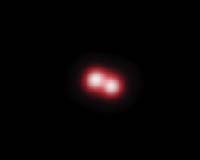
Chandra X-ray Observatory images of "cannonball star" RX J0822-4300.
by Dr. Tony Phillips
Boston MA (SPX) Nov 29, 2007
Astronomers using NASA's Chandra X-ray Observatory have discovered one of the fastest stars ever seen. It's a "cosmic cannonball" that is challenging theories to explain its blistering speed. The name of the star is RX J0822-4300. It's a neutron star created by the Puppis A supernova explosion about 3700 years ago. Three Chandra observations clearly show the neutron star moving away from the center of the blast. Speed: 3 million mph! At this rate, RX J0822-4300 is destined to escape the Milky Way just millions of years from now.

"This neutron star has got a one-way ticket out of the Galaxy," says Robert Petre of NASA's Goddard Space Flight Center in Greenbelt, Md, one of the study's co-authors. "Astronomers have seen other stars being flung out of the Milky Way, but few as fast as this."

Although the star is moving extremely rapidly, its motion is not easy to see, notes lead author Frank Winkler of Middlebury College in Vermont. "The star is so far away that the motion we see in five years is less than the height of the numerals in the date on a penny held 100 yards away. It's remarkable, and a real testament to the power of Chandra, that such a tiny angle can be measured."

This isn't the first time astronomers have found million-mph stars. So-called "hypervelocity stars" have been previously discovered shooting out of the Milky Way with speeds around one million miles per hour. One key difference between RX J0822-4300 and these other reported galactic escapees is the source of their speed.

Hypervelocity stars are thought to have been ejected by interactions with a supermassive black hole in the Galaxy's center, which can act as a sort of "gravitational slingshot." This neutron star, by contrast, was flung into motion by a supernova. Data suggest the explosion was lop-sided, kicking the neutron star in one direction and the debris from the explosion in the other.

The breakneck speed of the Puppis A neutron star is not easily explained, however, by even the most sophisticated supernova explosion models. "The puzzle about this cosmic cannonball is how nature can make such a powerful cannon," says Winkler. "The velocity might be explained by an unusually energetic explosion," but researchers remain unsure.

It's a high-speed mystery-courtesy of Chandra.

Community
Email This Article
Comment On This Article

Related Links
Chandra X-ray Observatory
Stellar Chemistry, The Universe And All Within It


Memory Foam Mattress Review
Newsletters :: SpaceDaily :: SpaceWar :: TerraDaily :: Energy Daily
XML Feeds :: Space News :: Earth News :: War News :: Solar Energy News


Discovering Teenage Galaxies
Cambridge, UK (SPX) Nov 28, 2007
Staring for the equivalent of every night for two weeks at the same little patch of sky with ESO�s Very Large Telescope, an international team of astronomers has found the extremely faint light from teenage galaxies billions of light years away. These galaxies, which the research team believes are the building blocks of normal galaxies like our Milky Way, had eluded detection for three decades, despite intensive searches.


  • Massive Canadian Oilfield Could Be Exploited Using New UK System
  • National Fuel Cell Center Launched With NSF Award
  • Analysis: Venezuela nixes dollars for oil
  • Limited Biofuel Feedstock Supply

  • Turkey's nuclear plant project to kick off in February: minister
  • ITER signs 80 mln euros deal with Japan
  • Where Does Stored Nuclear Waste Go
  • 'Alternative' nuclear energy forum opens in Bratislava

  • A Breathable Earth
  • Researchers Find Origin Of Breathable Atmosphere Half A Billion Years Ago
  • Study Reveals Lakes A Major Source Of Prehistoric Methane
  • Giant Atmospheric Waves Over Iowa

  • More than a billion trees planted in 2007: UN
  • Woods Hole Research Center Debuts New Image Mosaic That Will Strengthen Global Forest Monitoring
  • Indonesia's forests: a precious resource in climate change fight?
  • Dalai Lama bemoans deforestation of Tibet

  • Scientists to discuss ways to 'climate-proof' crops
  • Noah's Flood Kick-Started European Farming
  • Greenpeace slams 'unsustainable' new tuna quota
  • FAO report urges paying poor farmers to be green

  • NIST Measures Performance Of Auto Crash Warning Systems
  • German cars world champs, except in Germany
  • Honda Debuts All-New FCX Clarity Advanced Fuel Cell Vehicle
  • 300 Miles Per Gallon! Aptera Motors Unveils Ultra Efficient All-Electric and Plug-In Hybrid

  • Announcement Of Opportunity For Sounding Rocket And Balloon Flights
  • China to order up to 150 Airbus jets during Sarkozy visit: report
  • Time Magazine Recognizes The X-48B
  • Virgin to offer carbon offsets alongside drinks and perfume

  • Nuclear Power In Space - Part 2
  • Outside View: Nuclear future in space
  • Nuclear Power In Space
  • Could NASA Get To Pluto Faster? Space Expert Says Yes - By Thinking Nuclear

  • The content herein, unless otherwise known to be public domain, are Copyright 1995-2007 - SpaceDaily.AFP and UPI Wire Stories are copyright Agence France-Presse and United Press International. ESA Portal Reports are copyright European Space Agency. All NASA sourced material is public domain. Additional copyrights may apply in whole or part to other bona fide parties. Advertising does not imply endorsement,agreement or approval of any opinions, statements or information provided by SpaceDaily on any Web page published or hosted by SpaceDaily. Privacy Statement