|
 |
 |
 |
 |
 |
 |
 |
 |

 |
Centuries Of Land-Use Practices Profoundly Impact Earth System
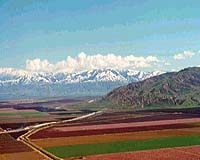
Durham NH (SPX) Jul 18, 2006 In a paper published in the July 2006 issue of Global Change Biology, University of New Hampshire scientists George Hurtt, Steve Frolking, and coauthors show that land-use activities over the last 300 years have substantially altered the land surface in ways that are likely to have had profound effects on the Earth system. Land-use changes have impacted some 42-68 percent of the global land surface, according to the study, which used historical records, satellite data, and computer modeling to reconstruct 216 different global land-use reconstructions to derive the most comprehensive picture to-date. "This is the first global land-use history description that's designed specifically to allow global carbon and climate models to assess the impacts of land-use history both on the past and current sources and sinks of carbon and climate," says Hurtt, assistant professor of natural resources at the UNH Institute for the Study of Earth, Oceans, and Space (EOS) and Department of Natural Resources. According to Hurtt, this global land-use data will allow the next generation of coupled carbon-climate models, known as Earth-system models, to include the most advanced representations of land-use practices yet, including the first mapped estimates of the effects of shifting agriculture, logging, and secondary recovering lands. "Land-use activities are known to have added large amounts of carbon dioxide to the atmosphere, altered surface reflectivity, and led to habitat alteration and destruction," says Hurtt. "A major challenge for scientists now is to understand the combined effects of these activities on the dynamics of the carbon-climate system. This study provides a key basis for these assessments." Land-use history is critical to understanding the dynamics of the carbon-climate system, not just for technical reasons but also for policy reasons. One of the big policy debates is to what extent carbon sinks in ecosystems should be able to offset carbon emissions. "It is important to know if a carbon sink in an ecosystem today is simply the result of recovery from having been cut down in the past, or a net new storage for carbon over the long term," says Hurtt. Moreover, he notes, without this historical analysis of land-use activities, even the most sophisticated models would be inaccurate. "Even if you didn't care about the past and wanted to focus on future global environmental changes, you would still have to first 'initialize' your model to the current state of the planet. Because the current state has been altered by a history of land-use activities over most of the planet, knowledge of historical activities increases the knowledge of the current conditions," Hurtt says of the work. Late last year, Hurtt presented the land-use research, now published in Global Change Biology, in a "platform" presentation at the Seventh International Carbon Dioxide Conference held in Boulder, Colorado. Since that time, the presentation has been downloaded more than 1,000 times by individuals interested in the data. UNH co-authors of the study include Berrien Moore and Matthew Fearon. The study was also co-authored by Steve Pacala, Elena Shevliakova, and Sergey Malysev of Princeton University, and Richard Houghton of the Woods Hole Research Center. Community Email This Article Comment On This Article Related Links Institute for the Study of Earth, Oceans, and Space Climate Science News - Modeling, Mitigation Adaptation
 Slab May Fall From Eiger Any Day
 Grindelwald, Switzerland (UPI) Jul 10, 2006
A geologist in Switzerland is warning Europe a massive rock slab may break away soon from the treacherous mountain of Eiger. Geologist Hans-Rudolf Keusen told the Times of London that any day now, a slab of rock weighing millions of tons may crash into the valley below. |
|
|

| The content herein, unless otherwise known to be public domain, are Copyright 1995-2006 - SpaceDaily.AFP and UPI Wire Stories are copyright Agence France-Presse and United Press International. ESA PortalReports are copyright European Space Agency. All NASA sourced material is public domain. Additionalcopyrights may apply in whole or part to other bona fide parties. Advertising does not imply endorsement,agreement or approval of any opinions, statements or information provided by SpaceDaily on any Web page published or hosted by SpaceDaily. Privacy Statement |