|
 |
 |
 |
 |
 |
 |
 |
 |

 |
Central Asian States Create Nuclear-Free Zone
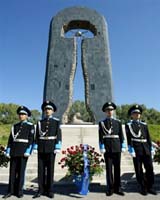
Semipalatinsk, Kazakhstan (AFP) Sep 08, 2006 Amid criticism from certain western powers, the five former Soviet states of Central Asia on Friday pledged to make their collective territories a nuclear weapons-free zone. At a ceremony held in the city of Semipalatinsk -- just 120 kilometres (75 miles) from the former Soviet Union's main testing ground for atomic bombs -- foreign ministers and ambassadors from the five states signed a treaty in which they pledged not to produce, acquire or deploy nuclear weapons or their components. Kazakh Foreign Minister Kassymjomart Tokayev said the treaty, which took nine years to negotiate, was "particularly relevant in the context of the fight against terrorism". The agreement should help prevent weapons of mass destruction "falling into terrorists' hands", he added. But for the treaty to enter into force, the signatories -- Kazakhstan, Kyrgyzstan, Tajikistan, Turkmenistan and Uzbekistan -- must sign a separate agreement with the five nuclear powers that are permanent members of the United Nations' Security Council. These are Britain, China, France, Russia and the United States. And some western diplomats are already saying that the treaty is not worth the paper it is written on. They argue that article 12 of the text does not call into question the terms of a collective security agreement between the five central Asian states and Russia, which allows Moscow to transport atomic weapons across the newly-created nuclear free zone. "Britain first raised this problem... The idea of this kind of treaty in Central Asia is very good but it still allows Russia to transport nuclear arms, which is contradictory," said a western diplomat based in Almaty. Tokayev rejected these criticisms and insisted there was "no contradiction". The disagreement over the treaty meant that while the Russian and Chinese ambassadors were present at the ceremony, along with UN representaties and members of the International Atomic Energy Agency (IAEA), the US, France and Britain were not represented. In a letter sent to the signing ceremony, UN Secretary General Kofi Annan urged the Security Council and the Central Asian states to try to patch up their differences. "I note that some nuclear states continue to be concerned about some aspects of the Central Asia nuclear-free zone treaty... I would therefore urge the five Central Asian states to engage with the nuclear weapon states with the view to bridging the differences and insuring the treaty's effective implementation," he wrote. The Soviet Union tested nearly five hundred atomic bombs at its complex near Semipalatinsk, irradiating 1.5 million people and around 10 percent of Kazakh territory, an area equivalent to the size of Germany. Kazakhstan is often held up as a model of nuclear non-proliferation. When it won independence from the Soviet Union, it gave up its massive nuclear arsenal, which was the world's fourth largest.
Source: Agence France-Presse Community Email This Article Comment On This Article Related Links Learn about nuclear weapons doctrine and defense at SpaceWar.com Learn about nuclear weapons doctrine and defense at SpaceWar.com Learn about missile defense at SpaceWar.com All about missiles at SpaceWar.com Learn about the Superpowers of the 21st Century at SpaceWar.com
 Economic Reforms Are Changing Hardline North Korea Some Say
 Seoul (AFP) Sep 10, 2006
While missile tests and nuclear weapons fill the headlines on North Korea, economic reforms introduced quietly four years ago are bringing about changes in the hardline communist state, analysts say. Reforms have progressed much further than previously recognized and as a result any collapse of the regime triggered by internal factors is "highly unlikely," US banking group Citigroup said in a July report. |
|
|

| The content herein, unless otherwise known to be public domain, are Copyright 1995-2006 - SpaceDaily.AFP and UPI Wire Stories are copyright Agence France-Presse and United Press International. ESA PortalReports are copyright European Space Agency. All NASA sourced material is public domain. Additionalcopyrights may apply in whole or part to other bona fide parties. Advertising does not imply endorsement,agreement or approval of any opinions, statements or information provided by SpaceDaily on any Web page published or hosted by SpaceDaily. Privacy Statement |