|
 |
 |
 |
 |
 |
 |
 |
 |

 |
Central American Fires Impact US Air Quality And Climate
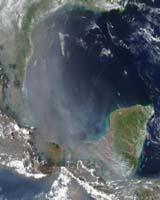
Greenbelt MD (SPX) Oct 11, 2006 A NASA-funded study published in the July 26, 2006 Journal of Geophysical Research-Atmospheres found that during April-May 2003, large amounts of smoke, which include aerosols -- tiny particles suspended in the air -- from biomass burning in the Yucatan Peninsula and southern Mexico reached Texas, Oklahoma, and other areas in the southeastern United States. The smoke plumes degraded visibility and air quality in coastal regions along the Gulf of Mexico and resulted in the greatest concentration of small particulate matter in southern Texas since 1998. By blocking incoming sunlight, the smoke plumes also cooled surface air temperatures over land. But higher in the atmosphere the smoke absorbed solar radiation and warmed temperatures. This created a circulation pattern that trapped smoke aerosols in the lower atmosphere, worsening air quality. The researchers used a newly developed computer model to simulate the transport and effects of smoke in the atmosphere and on the Earth's surface. The model couples aerosol properties with meteorology and uses hourly smoke emission data from the NASA-led Fire Locating and Monitoring of Burning Emissions (FLAMBE) project. FLAMBE is a joint effort by NASA, the U.S. Navy, the National Oceanic and Atmospheric Administration and university partners to develop smoke aerosol forecasting models for the benefit for the global weather community. "Although this computer model is not currently used in air-quality and weather forecasting, it is superior to other models for this purpose because it explicitly accounts for the diurnal variation of smoke emission from biomass burning fires and the radiative impacts of aerosols so that their impact on meteorology can be studied," said study co-author Sundar Christopher of the University of Alabama, Huntsville, Ala. Comparisons with ground-based observations and imagery from NASA's Moderate Resolution Imaging Spectroradiometer (MODIS) on the Terra and Aqua Earth Observing System satellites showed that the model accurately simulated the impact of smoke on air temperature and the amount of sunlight absorbed and scattered through the atmosphere. MODIS data was particularly useful in determining how aerosols from the Central American fires affected the amount of sunlight passing through the atmosphere, which can impact surface and atmospheric temperatures. "MODIS data allows us to capture the meteorological impacts of smoke and aerosols, especially important during the tropical dry season each spring when biomass burning peaks and pollutants are transported to the United States," said Christopher. Smoke particles and aerosols scatter incoming sunlight while black carbon aerosols absorb solar radiation, affecting the atmospheric temperature profile. In turn, this alters evaporation and cloud formation. Smoke particles also often act as cloud condensation nuclei -- small particles on which water vapor condenses and forms clouds -- influencing the formation and distribution of rainfall. When combined with certain weather patterns, these aerosols can also have a significant impact on local and regional air quality according to the study. This work demonstrated a new capability to improve air quality and climate forecasts, but researchers need to learn more about how smoke and aerosols impact clouds. "New satellite data, including that from the joint NASA and French Cloud-Aerosol Lidar and Infrared Pathfinder Satellite Observation satellite, should help us better understand cloud microphysical processes and how aerosols impact cloud formation," said Christopher. Combining this information with improved computer models will help scientists better understand the role of smoke and aerosols on the climate to improve forecasts, even when the pollutant source is thousands of miles away. The authors of this and a previous related study included former NASA Earth System Science fellow Jun Wang of Harvard University; Sundar A. Christopher and U. Nair, University of Alabama-Huntsville; Jeffrey Reid, Naval Research Laboratory; Jenny Hand, Colorado State University; Jim Szykman, NASA Langley Research Center; and Elaine Prins, University of Wisconsin. Community Email This Article Comment On This Article Related Links Journal of Geophysical Research-Atmospheres Goddard Space Flight Center Our Polluted World and Cleaning It Up Forestry News - Global and Local News, Science and Application
 Western Demand Drives Increase In Chinese Timber Imports
 Geneva (AFP) Oct 10, 2006
Western demand for Chinese furniture has fuelled a increase of more than threefold in China's wood imports, and illegal timber from Russia's vast forests is helping to sustain the industry, a United Nations agency said on Tuesday. In a report on China's influence on the timber market, the UN Economic Commission for Europe (UNECE) said that the Russian Far East represented the major source of raw materials for the Chinese industry, which has also become the world's leading exporter of forest products. |
|
|

| The content herein, unless otherwise known to be public domain, are Copyright 1995-2006 - SpaceDaily.AFP and UPI Wire Stories are copyright Agence France-Presse and United Press International. ESA PortalReports are copyright European Space Agency. All NASA sourced material is public domain. Additionalcopyrights may apply in whole or part to other bona fide parties. Advertising does not imply endorsement,agreement or approval of any opinions, statements or information provided by SpaceDaily on any Web page published or hosted by SpaceDaily. Privacy Statement |