|
 |
 |
 |
 |
 |
 |
 |
 |

 |
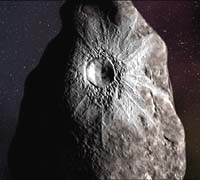
Centaur's Bright Surface Spot Could be Crater of Fresh Ice
Washington - September 14, 2000 The unexpectedly varied surface of a wayward piece of space debris has given Hubble telescope astronomers new insights into the characteristics and behavior of a ghostly population of faintly observed comet-like bodies that lie just beyond Pluto's orbit. While observing an object called 8405 Asbolus, a 48-mile-wide (80-kilometer) chunk of ice and dust that lies between Saturn and Uranus, astronomers using NASA's Hubble Space Telescope were surprised to find that one side of the object looks like it has a fresh crater less than 10 million years old, exposing underlying ice that is apparently unlike any yet seen. This shows that these mysterious objects do not have a simple homogenous surface, say researchers. Hubble didn't directly see the crater - the object is too small and far away - but a measure of its surface composition shows a complex chemistry. "To wildly speculate, there may have been an impact that heated this surface and did some different chemistry of the hydrocarbons present. This may be a solar system ice that hasn't yet been seen in other objects or generated in the lab," said Donald W. McCarthy of the University of Arizona (UA) in Tucson, Arizona. "The ice does have some strong similarities to water ice, but in places it really doesn't match," adds lead investigator Susan D. Kern of UA. "This could be a new mixture of things we've seen before, but not in this combination." By latest count, scientists have discovered a total of 21 Centaurs, which are dim, small bodies, which are icy like comet nuclei. These objects are considered escapees from a vast reservoir of comets, the Kuiper Belt beyond Pluto. The Centaurs' orbits were perturbed into the region between the orbits of Neptune and Jupiter. "Perhaps the event that caused the impact crater on 8405 Asbolus also knocked it out of the Kuiper belt," McCarthy speculates. As part of a survey of 10 Centaur objects, the Arizona team measured the surface composition of 8405 Asbolus on June 11, 1998. This was done by taking near-infrared spectra that measure the colors of sunlight reflected off the surface. Fortuitously, as it turned out, that day the Space Telescope instruments were briefly shut down to protect them from radiation interference as the spacecraft passed through one of the Earth's strong radiation belts of charged particles. Instead of observing the Centaur for an uninterrupted 40 minutes, the astronomers studied it in two separate sessions spanning almost two hours over which both hemispheres of the asteroid were visible. Initially the observers saw a relatively bright, very complicated absorption spectrum in one hemisphere. After the shutdown, when they looked again. The spectrum of 8405 Asbolus looked entirely different, showing a very smooth "normal" spectrum with few specific absorptions due to a complicated surface composition. This second spectrum matched what had been observed with the Keck Telescope three months earlier. But the first spectrum was a complete puzzle. "At first we didn't understand it, because NICMOS (Near Infrared Camera and Multi-Object Spectrograph data is really hard to reduce," McCarthy said. They used NICMOS' "grism" in the project. The grism is a grating of ruled, straight lines through a prism that separates light into spectra. Surfaces of objects in the outer solar system darken and redden with exposure to ultraviolet sunlight, solar wind and cosmic rays. Unexposed, interior ice remains bright. Light reflected from the bright spot of newly exposed ice dominates the spectrum when it spins into view. McCarthy says, "We believe we're seeing a more spherically shaped, dark object with a very bright crater on it." "And that�s what is interesting about this Centaur, that the bright spot isn�t just water ice." Kern adds. She was the first to suggest that the Centaur must be spinning twice as fast as previously thought, making a complete rotation every 4.5 hours. Kern, who just earned her UA bachelor�s degree in astronomy, is lead author on a paper about it to be published in Astrophysical Journal Letters. In addition to UA Steward Observatory astronomer McCarthy, co-authors include Mark W. Buie of Lowell Observatory, Robert H. Brown of the UA Lunar and Planetary Laboratory (LPL), Humberto Campins of LPL and the Research Corp., and UA astronomy professor Marcia Rieke.
Email This Article Comment On This Article Related Links Space Telescope Science Institute University of Arizona News Services SpaceDaily Search SpaceDaily Subscribe To SpaceDaily Express Stellar Chemistry, The Universe And All Within It
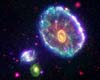
 Cartwheel Galaxy Makes Waves In New NASA Image
 Pasadena CA (JPL) Jan 12, 2006
A new image from NASA's Galaxy Evolution Explorer completes a multi-wavelength, neon-colored portrait of the enormous Cartwheel galaxy after a smaller galaxy plunged through it, triggering ripples of sudden, brief star formation.
--------------------------------------------------------- It's new. And it's downright terrific! Celestron's CPC Schmidt-Cassegrain telescope is the scope you've been waiting for! It offers new alignment technology, advanced engineering, and bold new design at a new, low price! In fact, Celestron's Professional Computerized (CPC) scope with revolutionary SkyAlign Alignment Technology redefines everything that amateur astronomers are looking for. It offers quick and simple alignment, GPS technology, unsurpassed optical quality, ease of use, advanced ergonomics, enhanced computerization and, most important, affordability. Want to view M-31 tonight? One button takes you there!
Shop for telescopes online at Telescopes.com! today!
|
|
|

|
|
|
|
|
|
|
|
|
|
|
|
| The content herein, unless otherwise known to be public domain, are Copyright 1995-2006 - SpaceDaily.AFP and UPI Wire Stories are copyright Agence France-Presse and United Press International. ESA PortalReports are copyright European Space Agency. All NASA sourced material is public domain. Additionalcopyrights may apply in whole or part to other bona fide parties. Advertising does not imply endorsement,agreement or approval of any opinions, statements or information provided by SpaceDaily on any Web page published or hosted by SpaceDaily. Privacy Statement |