
 |
 |
 |
 |
 |
 |
 |
 |
 |

 |
Caviar for the masses -- Japan offers 'Cavianne'
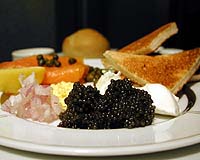
Aomori, Japan (AFP) June 19, 2008 As a plunge in the Caspian Sea's sturgeon population cuts caviar production, a Japanese factory has come up with a novel solution -- an imitation of the salty delicacy. Sticky grey liquid comes through tubes and quietly drips from nozzles, forming tiny balls that look like black caviar at the workshop in the city of Aomori, some 600 kilometres (370 miles) north of Tokyo. The imitation caviar, named Cavianne, is made from an unlikely mix of ingredients -- squid ink, pectin from apples, extract of sea urchin, oyster and scallop as well as a type of gum derived from kelp. Inventor Susumu Mikami, 75, said it took him two years to come up with the right mix of ingredients to produce small balls which he contends have almost the same size and taste as top-notch Beluga caviar. Mikami, a former maker of traditional Japanese sweets, invented Cavianne a decade ago and set up Hokuyu Foods Co. Ltd., which has five workers including himself as president. "Caviar from the Caspian Sea tastes really great. I've bought it about three times before," Mikami told AFP at his factory. "I'm making this by recalling what it tasted like." The most highly prized caviar comes from Beluga sturgeons in the Caspian Sea, which can live for more than 100 years. But despite their longevity, sturgeon populations have been diminishing rapidly from overfishing. Russia -- which along with Iran and former Soviet republics controls the catch -- earlier this year proposed a five-year moratorium to conserve sturgeon stocks. Caviar is traditionally produced by clubbing sturgeons and forcing out their eggs. Hokuyu Foods is the only maker of artificial black caviar in Japan. The company produces four tonnes of it a year, equal to one-fifth of the estimated consumption of real black caviar in Japan, according to Mikami. Few Japanese know the name Cavianne but the fake caviar has been mostly for wholesale for use at restaurants and hotels. Mikami first thought about making fake caviar when another member of a local group of inventors, the Invention Study Society, said grains from broom cypress look like caviar when sprinkled with squid ink. He thought they were too small for caviar and tasted bad, but he got to work. Cavianne looks like the prized Beluga caviar but Mikami himself admits the biggest problem is that the skin is too thick and gummy to be real. It is low in calories, containing just one-seventh of those in real black caviar, but Mikami wants to give it a richer taste for possible export. "There are people who adamantly refuse this -- cooks who know real caviar. I understand that," Mikami said. "It's alright for those who wants the real thing to stick to the real thing. But the real thing is disappearing. So if people are happy enough with our product on the menu, there is some role for us," he said. "I believe we can co-exist." One 50-gramme (1.75-ounce) jar of Cavianne is priced at some 1,000 yen (9.3 dollars), up to 10 times less than real black caviar. Mikami said he was still struggling to break even given the small scale of sales, but noted with hope that imitation crab is widely sold globally. For those who want something more casual than caviar, his company has another option -- bigger and colourful "Fruppy" balls that contain fruits-flavoured liquid. It is meant for use in beverages or topping for yogurt or other food. Community Email This Article Comment On This Article Share This Article With Planet Earth
Related Links Farming Today - Suppliers and Technology
 British minister sparks row over GM crops
 London (AFP) June 19, 2008
A British minister came under attack from environmentalists Thursday after suggesting that genetically-modified crops could help ease the global food crisis. |
|
|

| The content herein, unless otherwise known to be public domain, are Copyright 1995-2007 - SpaceDaily.AFP and UPI Wire Stories are copyright Agence France-Presse and United Press International. ESA Portal Reports are copyright European Space Agency. All NASA sourced material is public domain. Additional copyrights may apply in whole or part to other bona fide parties. Advertising does not imply endorsement,agreement or approval of any opinions, statements or information provided by SpaceDaily on any Web page published or hosted by SpaceDaily. Privacy Statement |
 del.icio.us
 Digg
Digg Reddit
 YahooMyWeb
 Google
 Facebook