|
 |
 |
 |
 |
 |
 |
 |
 |

 |
Causes Of Bulava Missile Test Failure Still Unknown
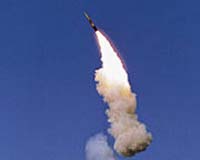
Moscow, Russia (RIA Novosti) Nov 29, 2006 Investigations into the failure of a test launch of the newest Russian ballistic missile a month ago have yet not been able to establish the causes of the incident, a Russian Space Agency official said Tuesday. A Bulava intercontinental ballistic missile launched October 25 from the Dmitry Donskoi nuclear submarine in the White Sea self-destructed after it deviated from its trajectory. "The causes of the failure are still unknown," said Vitaly Davydov, deputy head of the space agency. A Navy spokesman said at the time that the missile lifted off successfully from a submerged position, but strayed from its trajectory several minutes into the flight. "It could have triggered a self-destruct system," he said, adding that a special commission would conduct a detailed investigation into the incident. A similar test conducted September 7 also failed when a testing program error in the second stage of the flight caused the missile to miss its designated target. The R-30 Bulava (SS-NX-30) ballistic missile, a naval version of the Topol-M ballistic missile, was developed at the Moscow Institute of Thermal Technology. It can carry up to ten nuclear warheads and has a range of 8,000 kilometers (about 5,000 miles). The first in-flight test launch was conducted September 27, 2005 also from the Dmitry Donskoi, a Typhoon-class ballistic missile submarine. On December 21, 2005, another Bulava was launched from the Dmitry Donskoi in the White Sea before traveling thousand miles to hit a dummy target at the Kura test site, on the Kamchatka Peninsula. It was the first time a Bulava had been launched from a submerged position. Russia's Borey-class nuclear submarines could be equipped with Bulava missiles as early as 2008, the missile's chief designer said in April.
Source: RIA Novosti Community Email This Article Comment On This Article Related Links Russian Space Agency Rocket Science News at Space-Travel.Com
 NASA Awards Big Contract To Swales
 Hampton Va (UPI) Nov 28, 2006
The U.S. space agency NASA has selected Swales Aerospace of Beltsville, Md., to provide research and technology services to the agency's Langley Research Center. The indefinite delivery, indefinite quantity contract from the National Aeronautics and Space Administration has a maximum value of $200 million over five years, Swales said in a news release Tuesday. |
|
|

| The content herein, unless otherwise known to be public domain, are Copyright 1995-2006 - SpaceDaily.AFP and UPI Wire Stories are copyright Agence France-Presse and United Press International. ESA PortalReports are copyright European Space Agency. All NASA sourced material is public domain. Additionalcopyrights may apply in whole or part to other bona fide parties. Advertising does not imply endorsement,agreement or approval of any opinions, statements or information provided by SpaceDaily on any Web page published or hosted by SpaceDaily. Privacy Statement |