|
 |
 |
 |
 |
 |
 |
 |
 |

 |
Cauldron of Olympus
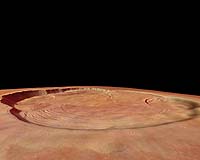
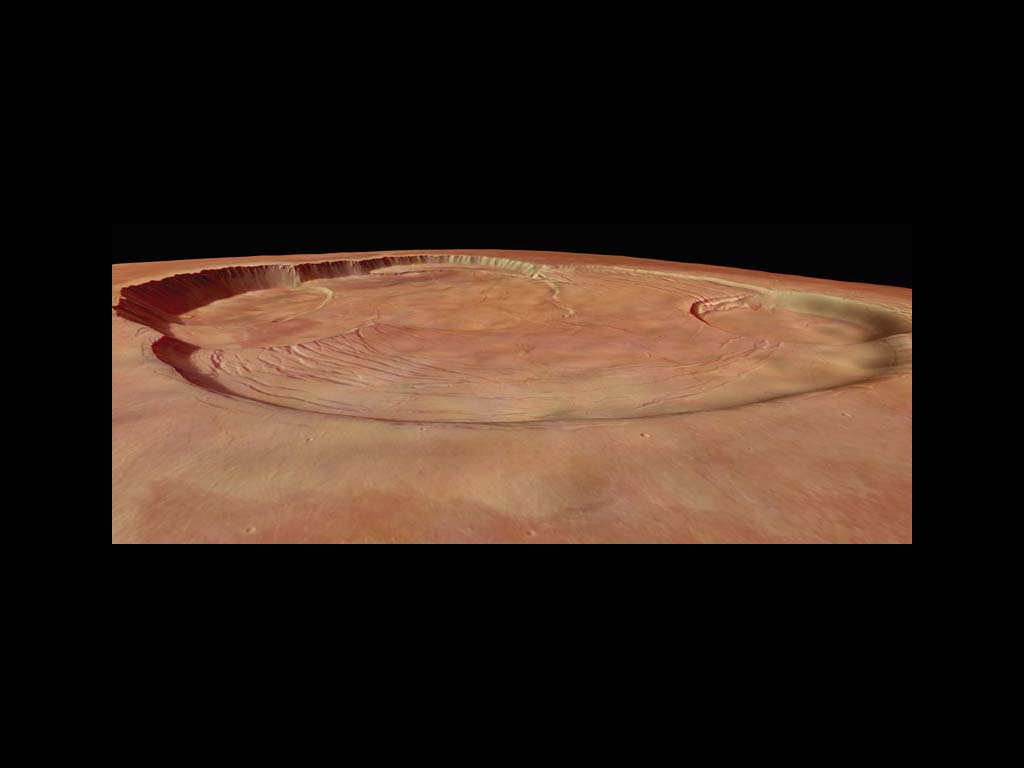
Paris (ESA) Aug 12, 2004 This perspective view, taken by the High Resolution Stereo Camera (HRSC) on board ESA's Mars Express spacecraft, shows the complex caldera of Olympus Mons on Mars, the highest volcano in our Solar System. Olympus Mons has an average elevation of 22 kilometers and the caldera, or summit crater, has a depth of about 3 kilometers. The data was retrieved during orbit 143 of Mars Express on 24 February 2004. The view is looking north. The curved striations on the left and foreground, in the southern part of the caldera, are tectonic faults. After lava production has ceased the caldera collapsed over the emptied magma chamber. Through the collapse the surface suffers from extension and so extensional fractures are formed. The level plain inside the crater on which these fractures can be observed represents the oldest caldera collapse. Later lava production caused new caldera collapses at different locations (the other circular depressions). They have partly destroyed the circular fracture pattern of the oldest one. This perspective view of the caldera was calculated from the digital elevation model derived from the stereo channels and combined with the nadir and colour channels of the HRSC. Community Email This Article Comment On This Article Related Links Mars Express SpaceDaily Search SpaceDaily Subscribe To SpaceDaily Express Mars News and Information at MarsDaily.com Lunar Dreams and more
 Spirit Heading To 'Home Plate'
 Pasadena CA (JPL) Jan 09, 2006
Last week Spirit completed robotic-arm work on "El Dorado." The rover used all three of its spectrometers plus the microscopic imager for readings over the New Year's weekend. |
|
|

| The content herein, unless otherwise known to be public domain, are Copyright 1995-2006 - SpaceDaily.AFP and UPI Wire Stories are copyright Agence France-Presse and United Press International. ESA PortalReports are copyright European Space Agency. All NASA sourced material is public domain. Additionalcopyrights may apply in whole or part to other bona fide parties. Advertising does not imply endorsement,agreement or approval of any opinions, statements or information provided by SpaceDaily on any Web page published or hosted by SpaceDaily. Privacy Statement |