|
 |
 |
 |
 |
 |
 |
 |
 |

 |
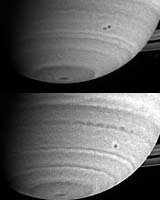
Caught In The Act: Two Storms Merging On Saturn
Pasadena - Apr 13, 2004 Three months before Saturn arrival, the Cassini spacecraft has observed two storms in the act of merging into one larger storm. This is only the second time this phenomenon has been observed on the ringed planet. "Merging is one of the distinct features of storms in the giant planet atmospheres," said Dr. Andrew Ingersoll, member of the Cassini imaging team and professor of planetary science at the California Institute of Technology in Pasadena, Calif. "On Earth, storms last for a week or so and usually fade away when they enter the mature phase and can no longer extract energy from their surroundings. On Saturn and the other giant planets, storms last for months, years, or even centuries, and instead of simply fading away, many storms on the giant planets end their lives by merging. How they form, however, is still uncertain," Ingersoll said. With diameters close to 1,000 kilometers (621 miles), both storms were seen moving west, relative to the rotation of Saturn's interior, for about a month before they merged on March 19 through 20, 2004. The northern storm moved about twice as fast as the southern storm, 11 meters versus 6 meters per second (25 versus 13 mph) respectively. They approached each other like two cars on a highway and spun around each other in a counterclockwise direction as they merged. This is the opposite of how hurricanes spin in the southern hemisphere on Earth. Just after the merger, on March 20, the new storm was elongated in the north-south direction, with bright clouds on either end. Two days later the storm settled into a more circular shape and the bright clouds were spread around the circumference to form a halo. Whether the bright clouds are particles of a different composition or simply at a different altitude is uncertain. Although these storms move slowly west, storms at Saturn's equator move east at speeds up to 450 meters per second (1,000 mph), which is 10 times the speed of Earth's jet streams and three times greater than the equatorial winds on Jupiter. "Saturn is the windiest planet in the solar system," said Ingersoll, "and that's a huge mystery. We'll be getting closer to the planet all the way through June, so maybe we'll find out." Images from the Voyager spacecraft flybys of Saturn in August 1981 show storms partially merging, but to see them with Cassini this far out from Saturn is a mouthwatering surprise to scientists because they will get even closer during the Cassini four-year Saturn tour. "I'm optimistic because these images are already so good. The best is yet to come," said Ingersoll. Community Email This Article Comment On This Article Related Links Cassini Imaging Team Cassini-Huygens at JPL SpaceDaily Search SpaceDaily Subscribe To SpaceDaily Express Explore The Ring World of Saturn and her moons Jupiter and its Moons The million outer planets of a star called Sol News Flash at Mercury
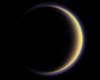
 Cassini Images Halo Around Titanic Moon Off Saturn
 Pasadena CA (SPX) Dec 27, 2005
With its thick, distended atmosphere, Titan's orange globe shines softly, encircled by a thin halo of purple light-scattering haze. |
|
|

| The content herein, unless otherwise known to be public domain, are Copyright 1995-2006 - SpaceDaily.AFP and UPI Wire Stories are copyright Agence France-Presse and United Press International. ESA PortalReports are copyright European Space Agency. All NASA sourced material is public domain. Additionalcopyrights may apply in whole or part to other bona fide parties. Advertising does not imply endorsement,agreement or approval of any opinions, statements or information provided by SpaceDaily on any Web page published or hosted by SpaceDaily. Privacy Statement |