
 |
 |
 |
 |
 |
 |
 |
 |
 |

 |
Caught In A Trap: Bumblebees Versus Robotic Crab Spiders
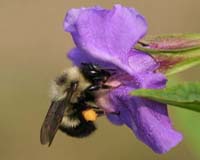
London, UK (SPX) Sep 10, 2008 Bumblebees learn to avoid camouflaged predators by sacrificing foraging speed for predator detection, according to scientists from Queen Mary, University of London. One of the bumblebee's main predators is the crab spider. Crab spiders hunt pollinating insects like bees and butterflies by lying in wait on flowers, and are particularly difficult for their prey to spot because they can change their colour to blend in with their surroundings. Dr Tom Ings and Professor Lars Chittka from Queen Mary's School of Biological and Chemical Sciences wanted to discover whether bumblebees could learn to avoid these crab spiders. Their study, funded by the NERC* and published in the journal Current Biology, shows how a run in with a spider affected the bees' foraging patterns. Dr Ings and his team allowed a colony of bumblebees (Bombus terrestris) to forage in a meadow of artificial flowers in a 'flight arena' which contained 'robotic' crab spiders. Some of the spiders were well hidden, others were highly visible. Whenever a bee landed on a flower which contained a robot spider, the spider 'caught' the bee by trapping it briefly between two foam pincers, before then setting it free to continue foraging. The team used 3D tracking software to follow the bees' movements, and found that the bees which were caught by a camouflaged spider slowed down their subsequent inspection flights. Although they lost valuable foraging time by slowing down, they were more likely to accurately detect whether there was a hidden crab spider present. In addition, the bees which had already been caught a few times the day before by the hidden spiders behaved as if they saw spiders where there were none i.e. they rejected foraging opportunities on safe flowers, 'just in case' and were more wary than bees which had been caught by the more conspicuous spiders. Dr Ings commented: "Surprisingly, our findings suggest that there is no apparent benefit to the spider in being camouflaged, at least in terms of prey capture rates. Spider camouflage didn't increase the chances of a bumblebee being captured, or reduce the rate at which the bees learnt to avoid predators. But our results did show that the bees which encountered camouflaged spiders were worse off in terms of reduced foraging efficiency." Community Email This Article Comment On This Article Share This Article With Planet Earth
Related Links Queen Mary, University of London
 Pesticide Build-Up Could Lead To Poor Honey Bee Health
 University Park PA (SPX) Aug 22, 2008
Honey bees industriously bring pollen and nectar to the hive, but along with the bounty comes a wide variety of pesticides, according to Penn State researchers. Add the outside assault to the pesticides already in the waxy structure of the hive, and bee researchers see a problem difficult to evaluate and correct. |
|
|

| The content herein, unless otherwise known to be public domain, are Copyright 1995-2007 - SpaceDaily.AFP and UPI Wire Stories are copyright Agence France-Presse and United Press International. ESA Portal Reports are copyright European Space Agency. All NASA sourced material is public domain. Additional copyrights may apply in whole or part to other bona fide parties. Advertising does not imply endorsement,agreement or approval of any opinions, statements or information provided by SpaceDaily on any Web page published or hosted by SpaceDaily. Privacy Statement |
 del.icio.us
 Digg
Digg Reddit
 YahooMyWeb
 Google
 Facebook