|
 |
 |
 |
 |
 |
 |
 |
 |

 |
Catch Mechanism For Future Space Tether Demonstrated
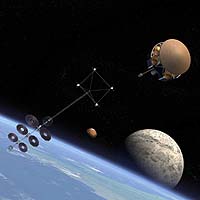
Huntsville AL (SPX) Jul 13, 2005 A team of university graduate students and faculty from Tennessee, with the help of NASA engineers, have "launched" a subscale spacecraft model and caught it in mid-air with a unique rendezvous or "catch" mechanism. Their successful demonstration of this mechanism that could grab a payload or craft traveling in space marks a critical milestone in development of a tether-based propulsion system. The professors and graduate students at Tennessee Technological University in Cookeville designed, built and recently tested the subscale tether catch mechanism in a university laboratory. Tether technology, as potentially implemented in space, transfers energy and momentum -- called momentum exchange -- from the tip of a fast-moving, spinning tether to a slower-moving object, dramatically increasing the object's speed. As the tether -- a long cable, approximately 60 to 90 miles in length -- spins end-over-end in space, it catches a payload in low Earth orbit via a catch mechanism, carries it for a half-rotation, and throws the payload toward its final destination. To restore the energy and momentum transferred to the payload, the tether then uses sunlight collected by onboard solar panels to drive electrical current through electrically conductive portions of the tether. The magnetic field generated by this current pushes against the Earth's magnetic field and slowly returns the tether to its original orbit. This technique, called electrodynamic reboost, restores the tether's momentum and energy, and prepares it for the next payload. Together, momentum exchange and electrodynamic reboost are keys to the Momentum Exchange/Electrodynamic Reboost or MXER tether, an emerging propulsion technology being studied by NASA. The catch mechanism test project was directed by Dr. Stephen Canfield, a mechanical engineering professor at Tennessee Tech. Canfield has investigated tether technology as a faculty researcher at the Marshall Space Flight Center each summer since 2001, working with Marshall's In-Space Propulsion Technology Project. In 2003, Canfield's team and Lockheed Martin Astronautics of Denver, Colo., were both awarded research contracts to develop catch mechanism designs for tether-based propulsion systems. NASA engineers from the In-Space Propulsion Technology Office closely participated in the design and development of the technology. Canfield's team conducted nearly 50 successful payload catch demonstrations of the lightweight mechanism -- capable of handling payloads 10 times heavier than its own weight -- between late February and early May 2005. The mechanism caught a free-flying, 25-pound simulated payload, launched from the floor of a Tennessee Tech laboratory. The payload was a one-tenth scale model of a generic spacecraft, with a stabilization gyroscope, batteries, sensors and a camera. While in a free-fall condition -- similar to the weightlessness of orbit -- the payload was then grabbed in mid-air by the catch mechanism, which hung from the laboratory ceiling, about 30 feet off the floor. The catch mechanism system uses gravity -- comparable to the centrifugal force generated by a tether's rotation in space -- to rapidly close the mechanism's aperture, or opening, around a boom connected to the payload. During the tests, electro-magnetic locks called solenoids held the aperture open and then were released to allow the mechanism to close and capture the payload. The test sequence accurately simulated the timing and acceleration of a real space-based tether system -- crucial capabilities for ensuring a successful catch in orbit. The team plans to conduct additional tests to demonstrate the use of sensors to automatically trigger the solenoids. They also intend to test heavier payloads and larger catch mechanisms. Tether technology is being developed by the In-Space Propulsion Technology Program, managed by NASA's Science Mission Directorate and implemented by the In-Space Propulsion Technology Office at Marshall. The program's objective is to develop in-space propulsion technologies that can enable or benefit near or mid-term NASA space science missions by significantly reducing cost, mass and travel times. Community Email This Article Comment On This Article Related Links Tethers and More at NASA Tennessee Tech University SpaceDaily Search SpaceDaily Subscribe To SpaceDaily Express Space Tourism, Space Transport and Space Exploration News
 Spicing Up Space Meals
 Los Angeles CA (SPX) Jan 04, 2006
Since its launch a year and half ago, Minimus.biz has quickly become the place to go for individual and travel size items. Last week, NASA came to Minimus.biz and purchased several different travel size condiments to send with the astronauts to the International Space Station. |
|
|

| The content herein, unless otherwise known to be public domain, are Copyright 1995-2006 - SpaceDaily.AFP and UPI Wire Stories are copyright Agence France-Presse and United Press International. ESA PortalReports are copyright European Space Agency. All NASA sourced material is public domain. Additionalcopyrights may apply in whole or part to other bona fide parties. Advertising does not imply endorsement,agreement or approval of any opinions, statements or information provided by SpaceDaily on any Web page published or hosted by SpaceDaily. Privacy Statement |