|
 |
 |
 |
 |
 |
 |
 |
 |

 |
Cassini's Tour de Saturn
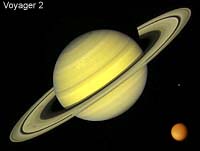
Cameron Park - May 25, 2001 Polar orbits around Saturn - such as Cassini will be in at the end of its Primary Tour - are ideal for observing Saturn's rings, weather patterns, and magnetosphere, and the changes that occur in all of them over time. But they are not very good for another of its major goals: more close flybys of its other moons, which are hard to set up even in an equatorial orbit. There are only seven such flybys during Cassini's first four years, but they are also clearly important. For one thing, the Primary Tour doesn't include any close, targeted flybys of two of Saturn's longest-known, "classic" moons: Mimas and Tethys. Mimas - about the same size as Enceladus - nevertheless shows no sign at all of the kinds of surface activity that its sister moon has, although like Enceladus it's in an orbit with a period exactly one-half that of the bigger moon Tethys. And Tethys - about the same size as Dione - shows some of the same signs of icy geological activity during its early days as Dione and Rhea, including a huge rift valley. During the Primary Tour, Cassini will make seven "nontargeted" flybys of Mimas, and five of Tethys - that is, flybys which it just happens to make while on its way to another destination - and these, along with 15 such flybys of Saturn's other inner moons, will allow far sharper observations of them than the Voyagers got. But such nontargeted flybys will still be quite distant - anywhere from several thousand to 100,000 km - and clearly one or more close flybys of these two moons should be added. Scientists also very much want to make a second close flyby of Iapetus (which, as I said, is hard to set up). Another possibility is that - once Cassini's primary mission is safely over, and its dust detector has given us a better idea of how much unseen debris is orbiting beyond the rings' visible edge - it may venture closer to the edge of the rings to study them and their complex and super-detailed structure at closer range. For instance, the skinny F Ring undergoes big and remarkable changes over time, as a result of the changing tuggings from its two "shepherds" and the more distant moons. It even seems to occasionally form temporary "clumps", which then disperse again as the gravitational pulls on them change. Some of these briefly fooled the Hubble Telescope's operators into thinking it had found some new inner moons of Saturn and, in fact, Prometheus and Pandora are so low-density and "fluffy" that they seem to be two larger clumps of material that managed to endure. Close passes might also allow Cassini to make close flybys of Saturn's two "co-orbital" satellites, Janus and Epimetheus, which may be the halves of a single moon that was cracked completely in two by a giant impact at some point during Saturn's history and has been futilely trying to put itself back together again ever since. Their near-identical orbits cause one of them to periodically creep up on the other one from behind - but then, just when they're on the verge of being pulled directly toward each other, that pull causes the leading moon to slow down and then fall into a slightly lower and faster orbit, and causes the trailing moon to speed up slightly and then climb into a slightly higher and slower orbit - and so, bizarrely, they then start to start to pull back away from each other until the whole strange dance resumes a few years later with the partners in the reverse roles. This is surely one of the weirdest tricks that orbital mechanics can pull. Cassini will have swooped just 5500 km outside their orbits twice during the Primary Tour, so bringing it close enough for actual flybys may be quite feasible. Finally, there's Titan itself. Cassini will have made fully 44 close flybys of the giant moon, and the Huygens probe will actually have parachuted down through its atmosphere and perhaps even survived a landing on its surface - but, strangely, program manager Robert T. Mitchell tells me that Cassini's scientists feel that further studies of Titan may actually still be the single highest priority goal of a Cassini extended mission. The reason is simply that the amount of Titan's surface which Cassini's imaging radar can map in detail is quite small - less than one percent of the surface per pass, so that only about 35% of Titan's surface will have been radar-mapped with a resolution of 1.5 km or better after four years. Close-up coverage by its cameras and VIMS spectrometer (even if they are able to see fairly well through Titan's organic smog layer) may not be much better. As I noted earlier in this series, we know almost nothing about Titan's surface, except that it's surely covered with complex geological phenomena. (Seas and rivers of liquid natural gas? Volcanoes of ice spewing water-ammonia "lava"? Mountain ranges with methane snowcaps?) The the more of it we view in detail, the better. At any rate, I hope I've given some idea of the torrent of scientific data we're likely to gain from Cassini. We all know about the cascade of spectacular scientific discoveries made about Jupiter and its moons by the Galileo craft, despite its crippling communications problems. Cassini has no such problem, can communicate at a rate 100 times faster, and will be able to spew hundreds of pictures (and other data) back to Earth each day. It remains possible, of course, that the craft will run into some serious problem before it reaches Saturn, but the fact that it and ALL its scientific instruments are working absolutely perfectly at the halfway point of its seven-year journey (and that it's full of backup systems) now makes it look very likely that - even if the Huygens probe should run into some unexpected problem during its descent onto Titan - Cassini itself will be able to fulfill most or all of its own scientific goals. It may be the most expensive planetary spacecraft ever built, but it's starting to look as though all that spending may well pay off.
Email This Article Comment On This Article Related Links SpaceDaily Search SpaceDaily Subscribe To SpaceDaily Express Space
 Satellite Launch To Boost DTH In India
 Calcutta, India (SPX) Dec 28, 2005
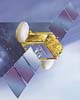
The successful launch Thursday of India's heaviest satellite from spaceport of Kourou in French Guyana may have boosted the country's space research efforts to yet another level, but it has also lifted the spirits of at least three Direct-To-Home televisions broadcasters, one of which has been waiting for years to launch its services in India. |
|
|

|
|
|
|
|
|
|
|
|
|
|
|
| The content herein, unless otherwise known to be public domain, are Copyright 1995-2006 - SpaceDaily.AFP and UPI Wire Stories are copyright Agence France-Presse and United Press International. ESA PortalReports are copyright European Space Agency. All NASA sourced material is public domain. Additionalcopyrights may apply in whole or part to other bona fide parties. Advertising does not imply endorsement,agreement or approval of any opinions, statements or information provided by SpaceDaily on any Web page published or hosted by SpaceDaily. Privacy Statement |