|
 |
 |
 |
 |
 |
 |
 |
 |

 |
Cassini's Radar Spots Giant Crater On Titan
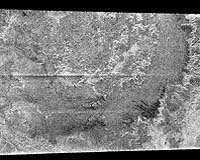
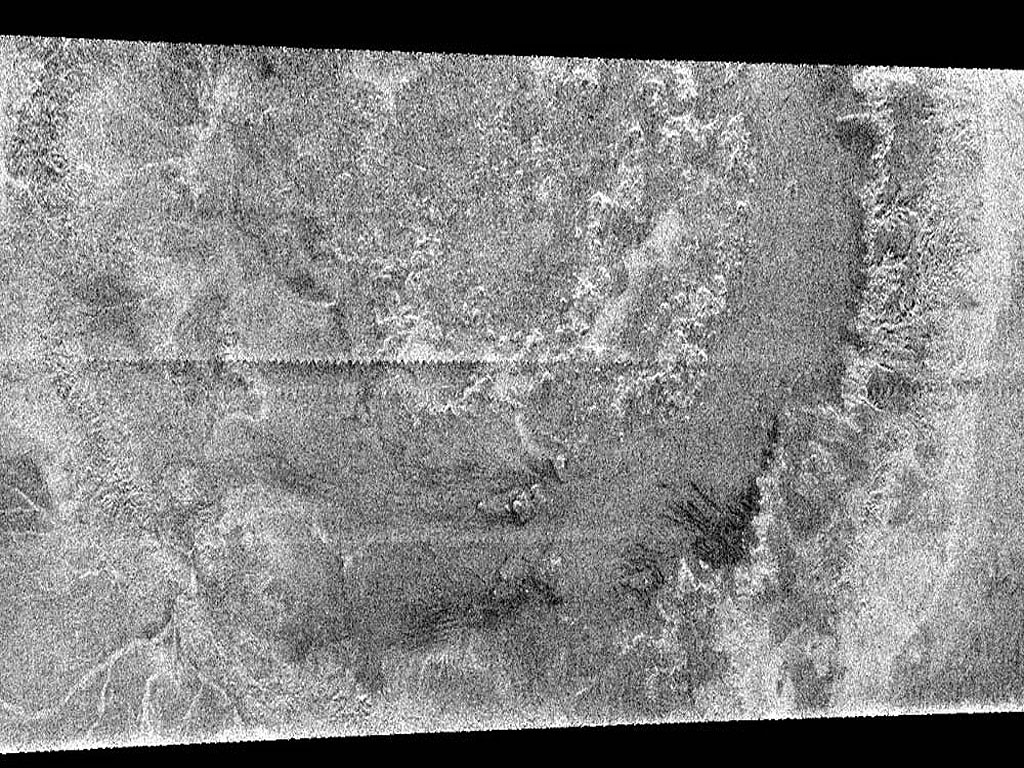
Pasadena CA (JPL) Feb 17, 2005 A giant impact crater the size of Iowa was spotted on Saturn's moon Titan by NASA's Cassini radar instrument during Tuesday's Titan flyby. Cassini flew within 1,577 kilometers (980 miles) of Titan's surface and its radar instrument took detailed images of the surface. This is the third close Titan flyby of the mission, which began in July 2004, and only the second time the radar instrument has examined Titan. Scientists see some things that look familiar, along with scenes that are completely new. The new radar images are available at: http://saturn.jpl.nasa.gov and http://www.nasa.gov/cassini. "It's reassuring to look at two parts of Titan and see similar things," said Dr. Jonathan Lunine, Cassini interdisciplinary scientist from the University of Arizona, Tucson. "At the same time, there are new and strange things." This flyby is the first time that Cassini's radar and the imaging camera overlapped. This overlap in coverage should be able to provide more information about the surface features than either technique alone. The 440-kilometer-wide (273-mile) crater identified by the radar instrument was seen before with Cassini's imaging cameras, but not in this detail. A second radar image released today shows features nicknamed "cat scratches". These parallel linear features are intriguing, and may be formed by winds, like sand dunes, or by other geological processes. On Thursday, Cassini will conduct its first close flyby of Saturn's icy moon Enceladus (en-SELL-uh-duss) at a distance of approximately 1,180 kilometers (730 miles). Enceladus is one of the most reflective objects in the solar system, so bright that its surface resembles freshly fallen snow. Community Email This Article Comment On This Article Related Links Cassini-Huygens at JPL Cassini Imaging Team SpaceDaily Search SpaceDaily Subscribe To SpaceDaily Express Explore The Ring World of Saturn and her moons Jupiter and its Moons The million outer planets of a star called Sol News Flash at Mercury
 Cassini Images Halo Around Titanic Moon Off Saturn
 Pasadena CA (SPX) Dec 27, 2005
With its thick, distended atmosphere, Titan's orange globe shines softly, encircled by a thin halo of purple light-scattering haze. |
|
|

| The content herein, unless otherwise known to be public domain, are Copyright 1995-2006 - SpaceDaily.AFP and UPI Wire Stories are copyright Agence France-Presse and United Press International. ESA PortalReports are copyright European Space Agency. All NASA sourced material is public domain. Additionalcopyrights may apply in whole or part to other bona fide parties. Advertising does not imply endorsement,agreement or approval of any opinions, statements or information provided by SpaceDaily on any Web page published or hosted by SpaceDaily. Privacy Statement |